
Weddings, corporate gatherings, birthday parties, graduations — every one of them needs tables, chairs, tents, linens, and decor that nobody wants to buy and store permanently.
- $8.5 billion in U.S. party rental revenue in 2025
- $5.7 billion in event-specific rental revenue projected for 2026
- Strong margins and a lower barrier to entry than most people assume
This guide walks through every step with real numbers — no vague “it depends” advice.
Why the event rental market is worth entering now
The global party and event rental market reached $20.46 billion in 2025 and is expected to climb to $23.21 billion in 2026. That is not a slow-growth industry coasting on momentum. Themed events grew by 58%, and AV equipment adoption jumped 52% year-over-year.
Three things are driving this:
- Post-pandemic event culture is fully back. Weddings, corporate retreats, and milestone celebrations are happening at pre-2020 rates — and people are spending more per event than before.
- Nobody wants to own event equipment. A couple throwing a wedding needs 150 chairs for exactly one day. Renting is the only option that makes sense for them. That is built-in, recurring demand.
- Small operators can compete locally. You do not need a national brand to win. A well-run party rental business serving a 30-mile radius can generate $100,000 to $300,000 in annual revenue with profit margins between 40-70%.
The operators who do well pick a niche, start lean, and build a reputation through reliable delivery and clean equipment. You do not need to serve every event type on day one.
Figure out what it actually costs to start
A party rental startup does not require massive capital to get going. Most small operations launch with $10,000 to $50,000 depending on inventory scope, vehicle, and storage setup.
Here is a realistic breakdown for a starter operation focused on tables, chairs, and linens:
| Expense | Estimated cost |
|---|---|
| Tables (25-40 units, mix of round and rectangular) | $2,000-$6,000 |
| Chairs (150-250 units, folding or chiavari) | $2,250-$7,500 |
| Linens (tablecloths, napkins, runners — 100+ pieces) | $1,500-$4,000 |
| Tent (1-2 frame tents, 20×20 or 20×30) | $3,000-$8,000 |
| Delivery vehicle (used cargo van or box truck) | $10,000-$15,000 |
| Storage (first 3 months warehouse lease) | $1,500-$6,000 |
| Business registration + licenses | $100-$500 |
| Insurance (first year) | $1,500-$3,000 |
| Booking and rental management software | $35-$100/month |
| Marketing (website, signage, local ads) | $500-$2,000 |
| Total estimated range | $22,350-$52,000 |
You can start smaller. If you skip the vehicle (rent one per job at roughly $30/day plus mileage) and use your garage as initial storage, your startup costs drop to the $10,000-$15,000 range. That approach works for testing the market before committing to a warehouse lease.
Budget 10-15% of your equipment’s purchase price annually for cleaning, repairs, and replacements. Chairs get scuffed, linens stain, and tent canvas wears. Maintenance is not optional — it is what separates a professional operation from a side hustle that fades out.

Pick the right rental categories for your market
Not all event rental categories carry the same margins or demand. Here are the core categories, ranked by accessibility and profitability for new operators.
Tables and chairs
The backbone of every event rental business. Folding chairs cost $10-$15 each wholesale and rent for $1.50-$3 per chair per event. Chiavari chairs cost $30-$60 each and rent for $6-$10. Tables follow a similar markup. The margins are consistent, and demand is year-round.
Tents and canopies
Higher ticket items. A 20×20 frame tent costs $1,500-$3,000 to purchase and rents for $300-$800 per event. Tents require more storage space and setup labor, but they significantly increase your average order value.
Linens and tableware
Low cost, high turnover. Tablecloths, napkins, chair covers, and place settings cost little per unit and rent repeatedly. The labor is in laundering and quality control between events. Average transaction value for linens adds $200-$500 per order on top of furniture rentals.
Decor and lighting
String lights, centerpieces, arches, and backdrops. This is where you differentiate from the operator down the road who only rents tables and chairs. Wedding and corporate clients pay premium rates for curated decor packages.
Photo booths and specialty items
Photo booths carry some of the highest margins in event rentals — often 50-70% gross — and attract repeat corporate clients. LED dance floors rent for $450-$700/day with high rebooking rates.
Starting recommendation: Begin with tables, chairs, and linens. Add tents and decor in year two once your cash flow supports the inventory investment. Trying to stock everything at launch stretches your capital thin and complicates logistics.
Ready to track your growing event rental inventory without spreadsheets?
Try LendControl free for 14 days
No credit card required.
Handle the legal and insurance side before your first event
Skipping this step is the fastest way to end your business before it starts. One injury at an event, one damaged venue floor — without proper coverage, you are personally liable.
Business registration
- LLC formation: $50-$500 depending on your state. An LLC protects your personal assets if something goes wrong at an event.
- EIN from the IRS: Free, takes 5 minutes online.
- Local business license: $50-$200/year from your city or county clerk.
- Sales tax permit: Rentals are taxable in most states. Register with your state’s Department of Revenue.
- Tent permits: Tents over 400-700 square feet require a fire marshal permit and inspection in many jurisdictions.
Insurance
At minimum, you need general liability insurance — it covers injuries to guests and damage to venue property caused by your equipment. A full insurance package for a party rental business typically includes:
- General liability: ~$80/month ($957/year) — covers injuries and property damage claims
- Business Owner’s Policy (BOP): Bundles general liability + commercial property. Saves $200-$300/year compared to buying separately
- Inland marine: Covers equipment damage or theft at event sites
- Commercial auto: Required if you own a delivery vehicle
- Workers’ comp: Required once you hire employees
All in, expect $1,500 to $3,000 per year for a small operation. A complete bundled policy averages $2,510/year. Most venues require proof of $1 million to $2 million in general liability before they allow your equipment on-site.
Set up storage, delivery, and logistics
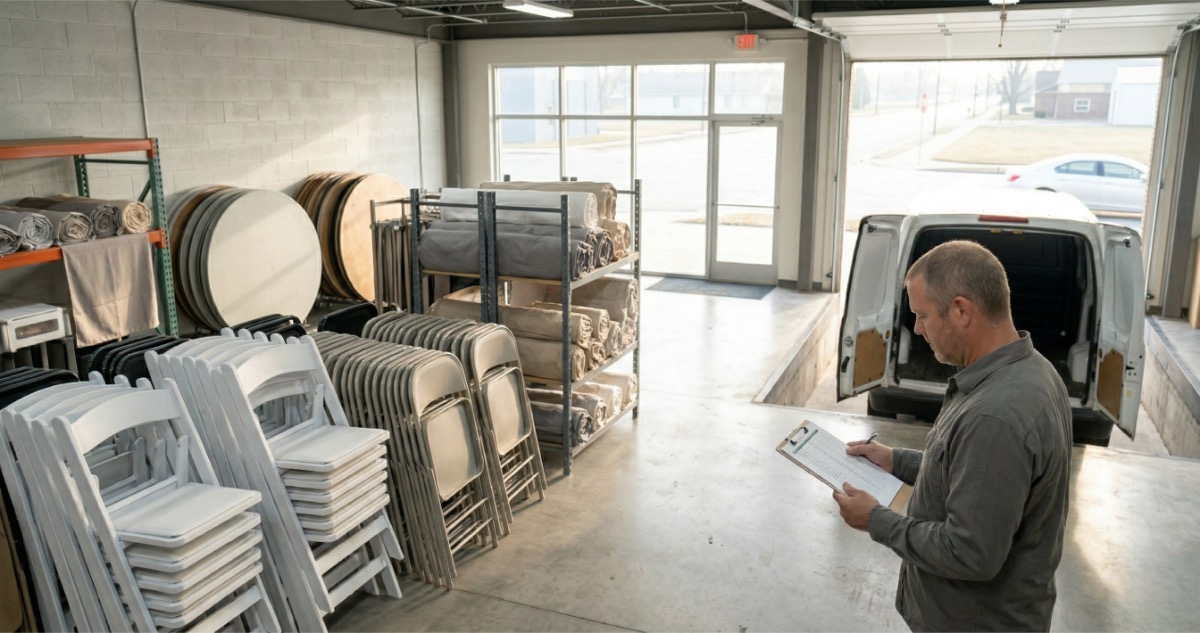
This is where many new operators underestimate costs and overestimate what their garage can hold. 250 chairs, 40 tables, linens, and even one tent take up serious space.
Storage
- Home garage or shed: Works for a minimal starter inventory. Saves $200-$500/month. But you will outgrow it fast.
- Warehouse or storage unit: $500-$2,000/month depending on your market. Look for units with drive-in access for easy loading.
Delivery vehicle
A used cargo van or box truck costs $10,000-$15,000 and is essential once you are doing more than 2-3 events per week. Until then, renting a vehicle per job at ~$30/day keeps your overhead low.
Factor in $300-$800/month for fuel and $500-$1,000/month for vehicle maintenance and insurance once you own a truck.
Delivery pricing
Most event rental companies charge $125-$300 per delivery depending on distance and order size. Delivery fees should cover your vehicle costs and labor — they are a profit center, not just a cost recovery line.
Price your rentals to cover costs and stay competitive
The industry standard is to charge 8-15% of the item’s purchase price per rental. That means a $50 chiavari chair rents for $5-$8 per event, and a $2,000 tent rents for $200-$400. With items turning 10-20 times per year for furniture and 25-50 times for smaller items, the math works.
Here are typical rental rates for a party rental business in 2026:
| Item | Rental rate per event |
|---|---|
| Folding chair | $1.50-$3 |
| Chiavari chair | $6-$10 |
| 60″ round table | $8-$15 |
| Rectangular banquet table | $8-$12 |
| Tablecloth (basic white/ivory) | $8-$15 |
| 20×20 tent | $300-$800 |
| String light package | $75-$150 |
| Photo booth | $200-$500/event |
Pricing tips that protect your margins
- Charge delivery and setup fees separately. Do not absorb them into rental prices — they are a distinct service.
- Require a damage deposit ($100-$500 depending on order size) to cover stained linens, broken chairs, or missing items.
- Bundle for weddings and corporate events. A “wedding package” with tables, chairs, linens, and lighting priced 10-15% below a la carte encourages larger orders.
- Seasonal pricing works. June through October is peak wedding and outdoor event season. Charge full rate. Offer 15-20% discounts in the off-season to keep your inventory moving.

Use event rental software to run operations
Once you are handling more than a few events per week, tracking inventory across overlapping bookings with spreadsheets or text messages becomes a liability. You double-book chairs that are already out at a Saturday wedding. You forget a delivery window. A customer messages you at 10 PM asking if you have 200 white chairs available for next Saturday, and you do not get back to them until Monday — by which time they have booked someone else.
Event rental software solves this by centralizing your inventory, bookings, and customer communication in one place. Here is what to look for:
- Real-time inventory tracking — every booking instantly updates what is available. No manual counting, no overlap.
- Online reservations — customers check availability and book without calling you during your busiest hours.
- Digital contracts and waivers — signed before the event. Protects you legally and eliminates paperwork at delivery.
- Payment processing — collect deposits and balances online, automatically.
- Customer communication — automated confirmations and reminders reduce no-shows and last-minute confusion.
One feature that stands out for event rental businesses: WhatsApp AI availability — a customer sends a message like “Do you have 150 chairs and 20 round tables available for June 14th?” and gets an instant answer pulled from your live inventory. No forms, no waiting for you to manually check. For operators fielding 10-30 availability questions a day through messaging apps, that is hours of back-and-forth eliminated every week.
Stop double-booking your event inventory. Join the LendControl waitlist and manage your entire rental operation from one dashboard.
Frequently asked questions
How much does it cost to start an event rental business?
Most small operations launch with $10,000 to $50,000, depending on inventory scope and whether you buy or rent a delivery vehicle and storage space. A tables-and-chairs-only operation can start closer to $10,000. Adding tents, linens, and a truck pushes toward $30,000-$50,000.
Is a party rental business profitable?
Yes. Profit margins for well-run event rental businesses typically range from 40-70%. A small operation can generate $100,000 to $300,000 in annual revenue with strong local demand and proper pricing.
What are the most profitable items to rent for events?
Tents, photo booths, and specialty decor carry the highest per-rental margins. Tables and chairs generate the most consistent demand. The best approach is to start with high-demand basics (tables, chairs, linens) and add higher-margin specialty items as your revenue grows.
Do I need insurance for an event rental business?
Absolutely. General liability insurance is required by most venues before they allow your equipment on-site. A full insurance package costs $1,500 to $3,000 per year for a small operation. Without it, one guest injury or property damage claim could shut you down.
What is the best way to start with limited capital?
Start with tables and chairs only — they require the lowest upfront investment and have the most consistent demand. Use your garage for storage, rent a delivery vehicle per job, and reinvest your first season’s profits into expanding your inventory. Many successful event rental business owners started with under $10,000 this way.
Start your event rental business the right way
An event rental business in a market with steady wedding, corporate, and social event demand is a strong small business opportunity. The industry is growing, the margins are healthy, and you do not need to stock a warehouse full of inventory on day one.
The operators who struggle are the ones who buy too much inventory before they have customers, skip insurance, or try to manage everything through text messages and spreadsheets once bookings start stacking up.
Get your inventory, get insured, price to cover your costs, and use event rental software to handle bookings and inventory from day one. Your future self — the one not frantically counting chairs in the warehouse at 6 AM before a Saturday wedding — will thank you.
Ready to run your event rental business without the chaos? Get started with LendControl for free — no credit card required.