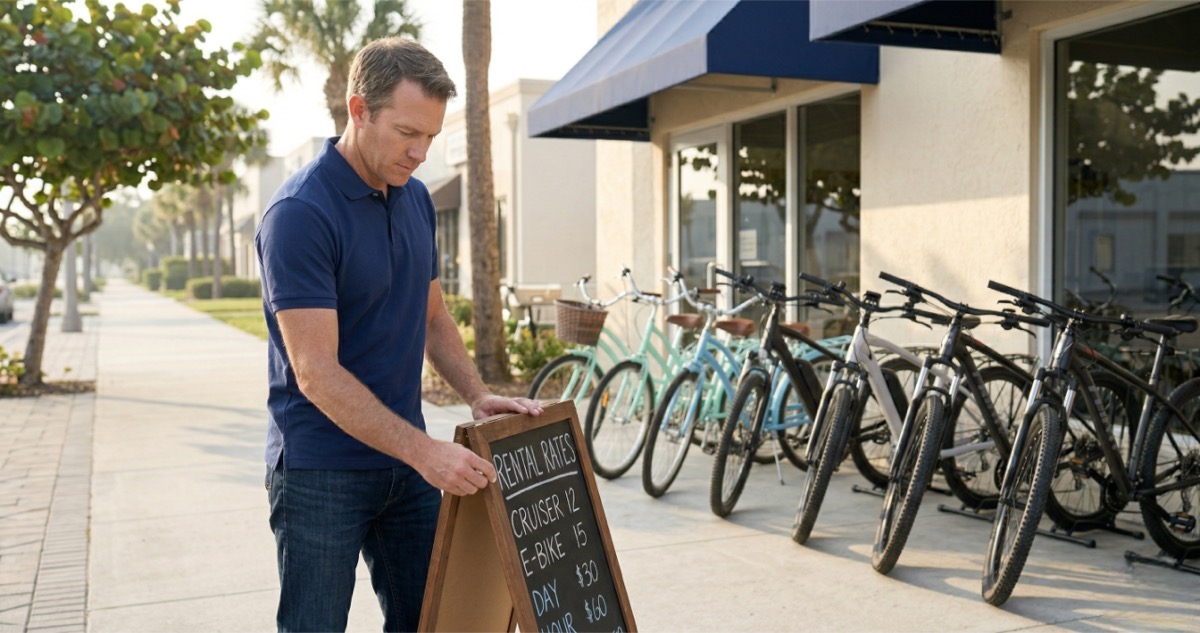

It is a Saturday morning in July. You have 25 bikes in your fleet, and 22 of them are supposed to be booked out. A family of four walks in for their 10 a.m. reservation — two adults, two kids.
- You check your spreadsheet — their bikes are listed as available
- You walk to the rack — two of those bikes are already gone
- Someone rented them to a walk-in an hour ago and forgot to update the sheet
Now you have angry customers, no bikes to give them, and a one-star review brewing.
- This is the most common operational failure in a bike rental business — and it is entirely preventable.
- Knowing where every bike is in real time — so no bike gets promised to two people.
- Scheduling maintenance so it does not collide with bookings — so serviced bikes are never accidentally reserved.
- Matching your fleet size to actual demand — so you are not overspending on idle inventory or turning away customers on peak days.
Here is how to get each one right.

The double-booking problem most bike rental shops ignore until it costs them
Double bookings do not happen because operators are careless. They happen because most small bike rental shops manage availability across too many disconnected channels — a paper calendar at the counter, a shared spreadsheet, phone calls, walk-ins, and maybe an online booking form that does not sync with anything.
When a customer books online while you are renting to a walk-in, neither system knows about the other. The same bike gets promised to two people. One of them loses.
The damage goes beyond one upset customer. A double booking triggers a chain reaction:
- Lost revenue — you either refund the booking or comp a future rental to make it right
- Reputation damage — one bad review about a “no-show reservation” can push customers to a competitor
- Staff stress — your team spends the next 30 minutes scrambling instead of serving other customers
- Cascading conflicts — if you shuffle bikes from a later reservation to cover the gap, you create a new double booking downstream
The fix is not “be more careful.” The fix is a system where every booking — online, walk-in, phone, or message — updates a single source of truth instantly.
Why spreadsheets fail at bike rental fleet management
Spreadsheets work fine when you have five bikes and a handful of bookings per week. Once you pass 15-20 bikes with daily turnover, they break down in predictable ways.
No real-time sync
When two staff members have the spreadsheet open on different devices, edits collide or overwrite each other. One person marks a bike as rented; the other does not see it for minutes — or hours.
No status granularity
A bike is not just “available” or “rented.” It might be reserved for a 2 p.m. pickup, out for maintenance, returned but not yet inspected, or flagged for a flat tire. Spreadsheets do not handle multi-state inventory well.
No channel integration
Your spreadsheet does not know when someone books through your website, sends a WhatsApp message asking about Saturday availability, or calls to reserve three mountain bikes. Every channel requires manual entry — and manual entry means human error.
No maintenance visibility
You cannot easily see which bikes are due for a tune-up, which ones had brake issues last week, or which e-bike batteries need charging before tomorrow’s bookings.
The result: operators spend hours on admin work that should take minutes, and weekend rushes become a guessing game.

Track every bike with real-time inventory status
Effective bicycle rental management starts with knowing the exact status of every bike at every moment. Not “roughly available” — exactly available.
Each bike in your fleet should have one of these statuses at all times:
- Available — inspected, clean, and ready to rent
- Reserved — booked for a future pickup, blocked from other reservations
- Rented — currently out with a customer
- Returned — back but awaiting inspection or cleaning
- Maintenance — out of rotation for repairs, tune-up, or charging (e-bikes)
- Retired — permanently removed from the rental fleet
When a customer books a bike — through any channel — the status should flip from “available” to “reserved” instantly, and that change should be visible to every staff member and every booking channel at the same time.
Use identifiers for every bike
Assign a unique ID, QR code, or barcode to every bike. Scanning a code at pickup and return is faster and more accurate than typing bike numbers into a spreadsheet. It eliminates mix-ups between similar-looking bikes and gives you a clean audit trail of every rental.
Set buffer times between rentals
Do not schedule back-to-back rentals with zero gap. Build in a 30-60 minute buffer between the return time of one rental and the pickup time of the next. That buffer covers late returns, quick inspections, and basic cleaning. Without it, a single late return creates a domino effect across your afternoon bookings.
Ready to stop double-booking your bike fleet?
Try LendControl free for 14 days
No credit card required.
Build a maintenance schedule that prevents booking conflicts
A bike that breaks down mid-rental is worse than a double booking. It is a safety issue, a liability risk, and a guaranteed refund.
Preventive maintenance keeps your fleet healthy and your availability predictable. The key is scheduling maintenance around your bookings — not in conflict with them.
Time-based maintenance
Schedule routine inspections on a fixed calendar — every 30, 60, or 90 days per bike, depending on usage intensity. For seasonal operations where mileage varies widely, time-based intervals ensure nothing slips through the cracks during slow periods.
A basic checklist for every 30-day inspection:
- Tire pressure and tread condition
- Brake pad wear and cable tension
- Chain lubrication and derailleur alignment
- Quick-release mechanisms and bolt tightness
- E-bike battery health and charge cycle count
Usage-based maintenance
Track rental hours or trip count per bike. High-use bikes — the ones that go out 5-6 times per week during peak season — need more frequent attention than bikes that rent twice a week. Set thresholds: after every 50 rentals or 200 hours of use, a bike gets a full service.
Block maintenance time in your booking calendar
This is the step most operators skip. When a bike is scheduled for maintenance, it should be automatically blocked from reservations during that window. If your system does not do this, you will book a bike that is sitting in the repair stand, and you are back to the double-booking problem.
Budget roughly $200 per bike per year for routine maintenance on standard bikes. E-bikes cost more due to battery replacements and electrical components.
Plan your fleet for seasonal demand swings
Most bike rental operations are seasonal businesses. Tourist-heavy locations see demand surge 30% or more on summer weekends, while winter months can drop below 20% utilization.
If your fleet is sized for peak demand, you are paying to store and maintain bikes that sit idle for months. If it is sized for average demand, you are turning away customers on your highest-revenue days.
Right-size your fleet with utilization data
Track your fleet utilization rate — the percentage of your fleet that is rented out on any given day. A healthy target is 60-70% during peak season. If you are consistently hitting 85%+ on weekends, you need more bikes. If you are below 40%, your fleet is too large for your market.
Seasonal fleet strategies
- Rotate bike types — push mountain bikes during summer trail season, shift toward city bikes and e-bikes in shoulder months when casual riders replace adventure tourists
- Temporary fleet expansion — partner with other rental operators or buy used bikes before peak season and sell them after. The cost of holding excess inventory year-round almost always exceeds the cost of seasonal buying and selling
- Retire worn fleet gradually — identify your highest-maintenance bikes at the end of each season and replace them before the next peak rather than spending another year on repairs
Track what actually rents
Not every bike type earns equally. If your mountain bikes sit while your e-bikes book solid, that is data telling you where to invest next year. Review rental counts by bike type monthly — not just at the end of the season when the data is stale.

Use rental software to tie it all together
Every problem in this article — double bookings, spreadsheet chaos, maintenance collisions, seasonal miscalculations — traces back to one root cause: disconnected information. Your booking calendar does not talk to your maintenance schedule, which does not talk to your walk-in availability, which does not talk to your online reservations.
The right rental software puts all of that into a single system. When someone books a bike, it is blocked everywhere. When a bike goes into maintenance, it disappears from available inventory. When a customer returns a bike, it queues for inspection before becoming bookable again.
Here is what matters most for bike rental fleet management:
- Single-source inventory — one place where every bike’s status is visible to all staff and all booking channels
- Automatic conflict prevention — the system blocks double bookings before they happen, not after
- Maintenance integration — scheduled service windows that automatically remove bikes from availability
- Customer communication — confirmations, reminders, and availability answers without manual work
With a synced system, your fleet inventory stays current across every channel. Customers can message you on WhatsApp — “Do you have any mountain bikes free Saturday?” — and get an instant answer pulled directly from your live inventory. No checking a spreadsheet, no calling back later, no missed bookings while you were helping someone in-store.
For a shop that fields 10-20 availability questions a day through messaging, that alone eliminates hours of back-and-forth and catches bookings you would otherwise lose.
Ready to manage your entire bike fleet from one dashboard?
No credit card required.
Frequently asked questions
How do I prevent double bookings in my bike rental business?
Use a centralized booking system where every reservation — online, walk-in, phone, or message — updates a single inventory in real time. When one customer books a bike, it should be instantly blocked from all other channels. Spreadsheets and paper calendars cannot do this reliably once you pass 10-15 bikes.
How often should I service my rental bikes?
Schedule a basic inspection every 30 days for all bikes. High-use bikes that rent 5+ times per week need a full service every 50 rentals or 200 hours. E-bikes require additional battery checks and electrical inspections. Always block maintenance time in your booking calendar so serviced bikes are not accidentally reserved.
What is a good fleet utilization rate for a bike rental business?
A healthy fleet utilization rate is 60-70% during peak season. Consistently hitting 85%+ means you are likely turning customers away and should expand. Below 40% means your fleet is oversized for your current demand or your marketing needs work.
How many bikes should I start with?
Most operators start with 10-20 bikes and scale based on first-season data. Starting small lets you test which bike types rent best in your market before committing to a larger fleet. Track utilization by bike type weekly so you know exactly where to invest when expanding.
Should I use QR codes or barcodes to track my rental bikes?
Yes. Assigning a unique QR code or barcode to each bike speeds up pickup and return, reduces data entry errors, and creates a clean rental history for every unit. Most rental software platforms support barcode scanning for fleet tracking.
Keep your fleet booked — not double-booked
Good bike rental fleet management is not complicated, but it does require a system. Know the status of every bike. Schedule maintenance without creating booking gaps. Size your fleet based on real utilization data, not guesswork.
The operators who run their fleet from a single, synced system spend less time fixing scheduling mistakes and more time growing their bike rental business. The ones still managing from spreadsheets and memory are one busy Saturday away from their next double-booking disaster.
Pick the right system now, before peak season forces the decision for you.