Every number you need to budget your event rental business — from folding chairs to box trucks, with no guesswork.
- You have been to enough weddings, corporate gatherings, and backyard parties to notice something — somebody is renting all those tables, chairs, and tents. And that somebody is making good money doing it.
- Before you buy your first stack of folding chairs, you need to know the real event rental startup cost — not a vague “$10K to $100K” range that tells you nothing.
- This guide breaks down every major expense line by line — with actual prices sourced from suppliers and industry data, so you can build a realistic budget and avoid the surprises that sink new operators.
Why the event rental market still has room for you
The U.S. party supply rental industry hit $8.5 billion in 2025, with event rental revenue forecast to reach $5.7 billion in 2026. Wedding counts are up, corporate events are back to pre-pandemic levels, and outdoor gatherings keep growing.
Here is what matters for you specifically: most markets are not saturated. There are roughly 7,400 party rental businesses across the entire U.S. That is not a lot for a country that hosts millions of events every year. If your area has a few established players but none that specialize in your niche — rustic weddings, corporate galas, backyard parties — there is space.
- Profit margins for well-run event rental businesses typically range from 10% to 40%
- Small operations can generate $50,000 to $100,000 annually
- Established businesses in metro areas reach $250,000 to $900,000+ in gross revenue
The numbers work. But only if you plan your startup costs correctly.
The real event rental startup cost — full breakdown
Here is what a mid-range party rental startup cost looks like for an operator targeting weddings and social events. This assumes enough inventory to serve 2-3 simultaneous events of 100-150 guests each.
| Expense category | Estimated cost | Notes |
|---|---|---|
| Tables (25-40 units) | $2,500-$8,000 | Folding rectangular ($65-$150) + round ($150-$270) |
| Chairs (150-250 units) | $1,800-$18,000 | Folding chairs $12-$15 each; chiavari $44-$72 each |
| Tents (2-4 units) | $5,700-$23,500 | 20×20 pole tents from ~$2,850; 20×40 frame tents from ~$5,880 |
| Linens and tableware | $2,000-$6,000 | Tablecloths, napkins, overlays in bulk |
| Lighting and decor | $1,000-$4,000 | String lights, uplights, basic decor pieces |
| Delivery vehicle | $10,000-$30,000 | Used 16ft box truck |
| Warehouse/storage | $6,000-$18,000/yr | 1,000-1,500 sq ft at $0.50-$1.00/sq ft/month |
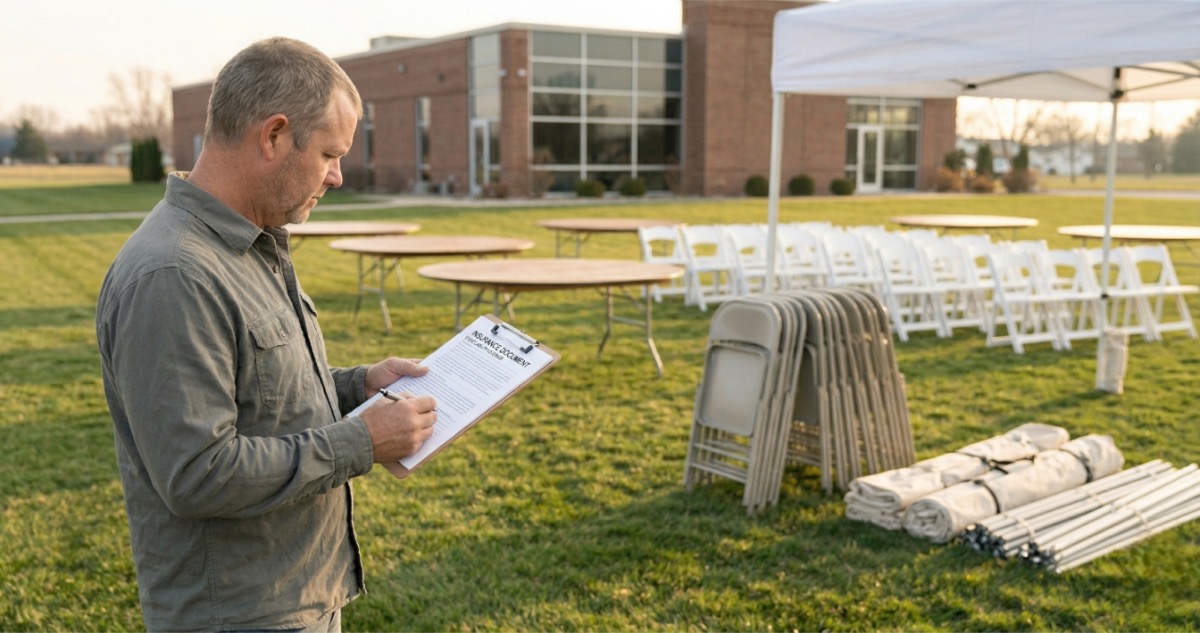
| Insurance (annual) | $1,500-$3,000 | General liability + commercial property |
| Business registration + licenses | $200-$1,000 | LLC, EIN, local permits |
| Rental management software | $50-$100/month | Booking, inventory, payments |
| Marketing (website, signage, ads) | $500-$2,000 | First-year digital presence |
| Total estimated range | $32,000-$115,000 | Mid-range operation targeting weddings/social events |
Two things to notice. First, tents and delivery vehicles eat most of your budget. If you skip tents initially and rent a truck per-event instead of buying one, you can start closer to $10,000-$15,000 with tables, chairs, and linens alone.
Second, the range is wide because your niche determines your costs. A backyard party rental operation is a very different business than a luxury wedding rental company.
What your inventory actually costs
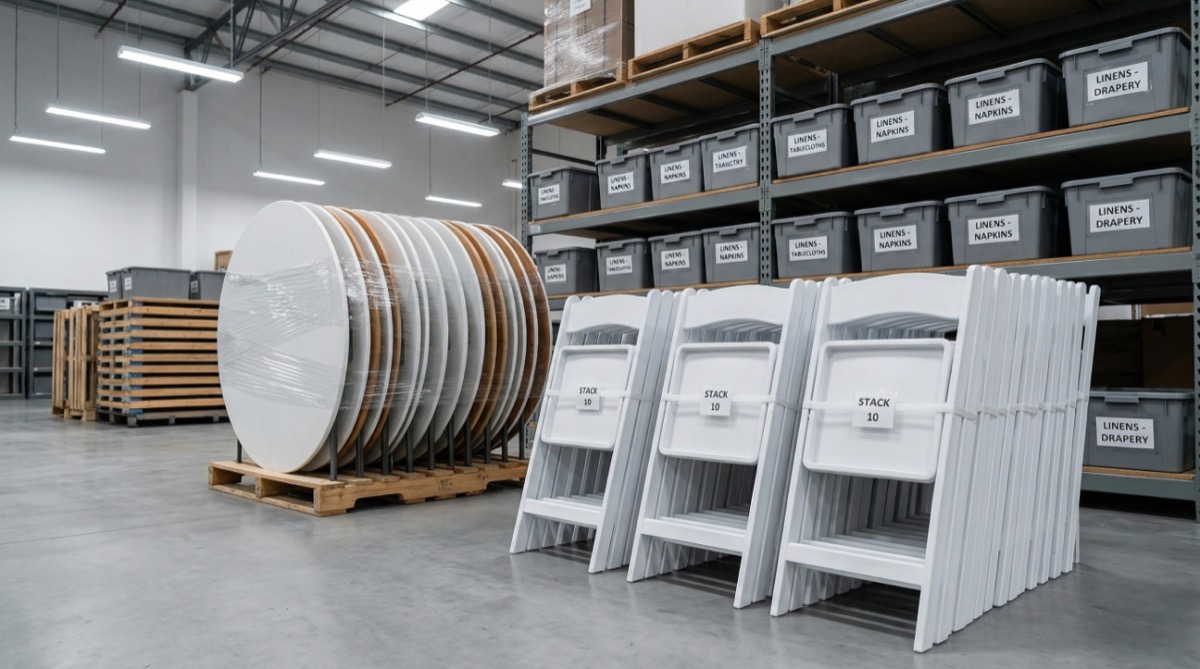
Your inventory is your revenue engine. Here is what each category costs at wholesale and what you can charge to rent it out.
Tables
- 6ft rectangular folding tables — $65-$150 each wholesale. Rental rate: $8-$15 per table per event.
- 60-inch round tables — $150-$270 each. Rental rate: $10-$18 per event.
- Cocktail/highboy tables — $60-$100 each. Rental rate: $12-$20 per event.
With 30 tables averaging $10 in rental revenue each, a single 150-guest event puts $300 in table rental fees alone. The tables pay for themselves after 3-5 events.
Chairs
- Plastic folding chairs — $12-$15 each in bulk, as low as $12 per unit for orders of 100+. Rental rate: $2-$4 each.
- Resin chiavari chairs — $44-$72 each wholesale. Rental rate: $6-$12 each. These are the premium option for weddings and upscale events.
At 150 chairs rented per event at $3 each, that is $450. If you bought folding chairs at $12 each ($1,800 total), you break even after just 4 events.
Tents
Tents are the most capital-intensive item in your inventory, but they command the highest rental fees.
- 20×20 pole tent — ~$2,850 to purchase. Rental rate: $200-$500 per event.
- 20×40 frame tent — ~$5,880 to purchase. Rental rate: $800-$1,500 per event.
A single 20×40 tent can pay for itself in 4-8 rentals. But tents also require setup labor, transport space, and maintenance — factor those ongoing costs in.
Linens, lighting, and extras
- Polyester tablecloths — $5-$12 each wholesale. Rental rate: $5-$15 each.
- Cloth napkins — $0.50-$2 each wholesale. Rental rate: $1-$3 each.
- LED uplights — $30-$60 each to purchase. Rental rate: $15-$25 per unit per event.
- String light sets (100ft) — $40-$80 each. Rental rate: $25-$50 per set.
Linens and lighting are high-margin add-ons. They cost very little relative to what you can charge, and they dramatically increase your average order value.
Ready to track all that inventory without spreadsheets? Join the LendControl waitlist — built for small rental operators who need real-time inventory tracking from day one.
Delivery, storage, and the costs people forget
Inventory is the glamorous part of planning. Delivery and storage are not — but they will quietly eat your margins if you do not budget for them.
Delivery vehicle
You need a way to move tables, chairs, tents, and linens to event sites. Your options:
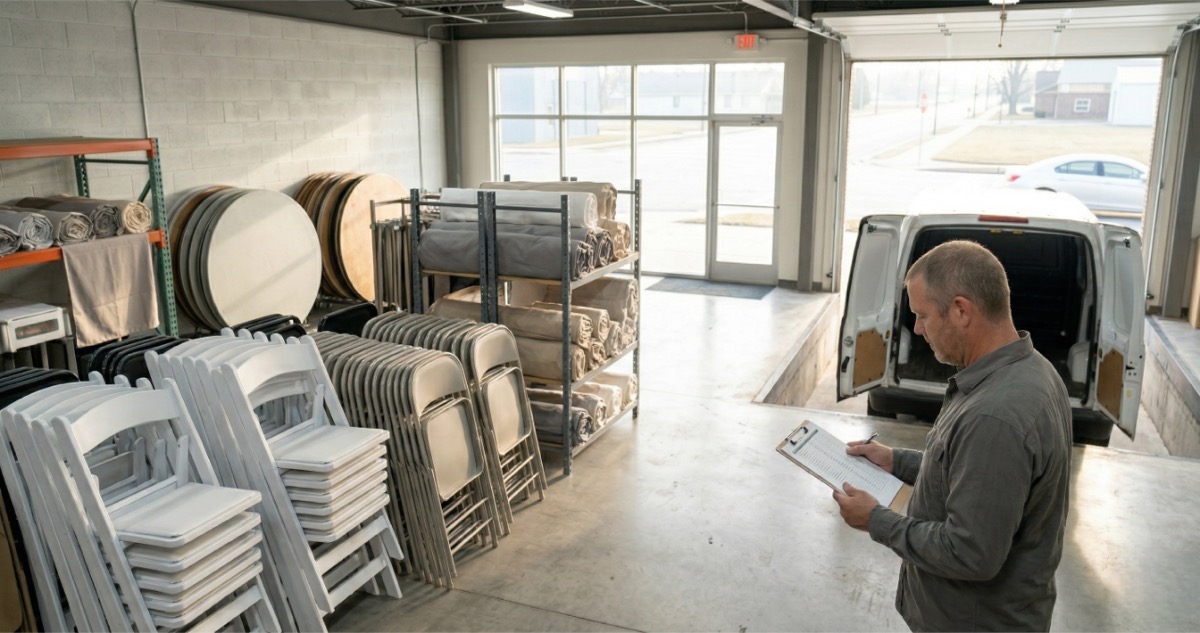
- Used 16ft box truck — $15,000-$30,000 to buy outright. This is the standard for mid-sized event rental operators. Budget $6,000-$10,000/year for fuel, maintenance, and commercial auto insurance.
- Cargo van — $8,000-$15,000 used. Works for smaller operations (chairs and linens, no tents).
- Rent per event — $40-$200/day depending on vehicle size. Smart for the first 6-12 months while you test demand.
If you are doing fewer than 4-5 events per month, renting makes more financial sense than owning. Once you cross that threshold, a purchased vehicle saves money fast.
Warehouse and storage
Your inventory needs a home. Tents, stacked chairs, tables, linens — this takes space.
- Small warehouse (1,000-1,500 sq ft) — $500-$1,500/month depending on your market. Rural areas average $0.50-$0.75/sq ft/month. Urban areas push $1.50-$2.50/sq ft/month.
- Self-storage unit — $150-$400/month for a 10×20 or 10×30 unit. Cheaper, but harder to load and organize efficiently.
- Home garage or barn — $0 if you have the space. Many operators start here. Just confirm local zoning allows commercial storage.
Start with the cheapest option that keeps your gear dry, accessible, and organized. Upgrade when you are doing enough events to justify the overhead.
Get licensed and insured before your first event
Skipping this step is how new operators get shut down — or bankrupted by a single accident.
Business formation
- LLC registration — $50-$500 depending on your state
- EIN (Employer Identification Number) — free from the IRS, takes 5 minutes online
- Local business license — $50-$400/year
- Sales tax permit — required in most states. Register through your state’s Department of Revenue.
Some cities require additional permits for tent setup on public or private property. Check with your local city clerk before booking your first event.
Insurance
This is non-negotiable. A guest trips over a tent stake, a table collapses, a tent blows over in wind — you need coverage.
- General liability — $500-$1,100/year for $1 million in coverage
- Commercial property/inland marine — $780-$840/year, covers your inventory against theft, fire, and damage
- Commercial auto — $1,200-$2,400/year if you own a delivery vehicle
- Workers’ comp — $360-$720/year if you hire employees
A comprehensive package runs $1,500-$3,000/year. Bundling policies typically saves 17-25% compared to buying them separately. Get at least $1 million per occurrence in general liability — most venues require it before they will let you set up.
Pick event rental software that pays for itself
Once you are juggling more than a handful of bookings per month, you need a system. Not a notebook. Not a spreadsheet. Actual event rental software that tracks your inventory, manages bookings, and handles payments.
Here is what to look for:
- Real-time inventory tracking — know exactly which items are booked, available, or in transit. No more double-booking 150 chairs for two Saturday weddings.
- Online booking and quotes — let customers see availability and request quotes without calling you.
- Digital contracts and waivers — signed before the event. Protects you legally and eliminates paper chasing.
- Payment processing — collect deposits and balances online. Fewer no-shows, faster cash flow.
- Automated customer communication — booking confirmations, delivery reminders, and follow-ups that happen without you.
Most event rental software runs $50-$100/month. At that price, it pays for itself the first time it prevents a double-booking or catches a missed payment.
LendControl is built specifically for small rental operations. The standout feature for event rental businesses: WhatsApp AI availability — customers message you asking “Do you have a 20×40 tent available for June 14?” and get an instant answer pulled from your live inventory. No forms, no waiting for you to check a spreadsheet and respond. For operators fielding 10-20 availability questions a day through messaging apps, that is hours of back-and-forth you never have to do.
Frequently asked questions
How much does it cost to start an event rental business?
A lean operation focused on tables, chairs, and linens can launch for $10,000-$15,000. A mid-range setup with tents, a delivery vehicle, and inventory for 150+ guests runs $30,000-$50,000. Premium operations targeting luxury weddings can exceed $75,000 in startup costs.
What is the most profitable event rental item?
Tents generate the highest per-rental revenue — a 20×40 frame tent that costs ~$5,900 to purchase rents for $800-$1,500 per event. Chiavari chairs are also high-margin, costing $35-$55 wholesale and renting at $6-$12 each. Lighting and linens offer the best margin percentage because their wholesale cost is very low relative to rental price.
Do I need a warehouse for an event rental business?
Not immediately. Many operators start with a garage, barn, or self-storage unit ($150-$400/month). Once your inventory grows beyond what fits in a residential space — or you are doing 8+ events per month — a small warehouse (1,000-1,500 sq ft) makes operations far more efficient.
How many events per month do I need to be profitable?
Most small operators break even at 4-6 events per month with average order values of $500-$1,000. At 8-12 events per month, you are generating $50,000-$100,000+ annually. Your break-even point depends on your fixed costs (storage, vehicle, insurance) and average ticket size.
Can I start an event rental business part-time?
Yes — and most people should. Events cluster on weekends, which means you can keep a day job while building your inventory and client base. Start with a focused niche (backyard parties, small weddings) and expand as demand grows. Just make sure your insurance and LLC are in place from day one.
Budget smart, then start booking
Knowing your full event rental startup cost upfront is the difference between a business that grows and one that runs out of cash after three months. The numbers are clear: a mid-range operation costs $30,000-$50,000, but you can start much leaner if you skip tents and rent your delivery vehicle.
Buy the inventory that pays itself back fastest — folding chairs, tables, and linens. Add tents and premium items as revenue allows. Get your insurance sorted, your LLC filed, and your event rental software set up before your first booking. The operators who survive year one are the ones who planned their costs before they spent a dollar.
Get Started for Free — no credit card required.