You’ve decided to start a bounce house rental business. Good call. But before you buy your first inflatable, you need to know exactly what you’re spending — and where.
Most “startup cost” guides online throw out a wide range ($10,000 to $50,000) and call it a day. That’s not helpful. You need a line-by-line breakdown so you can budget accurately and avoid surprises.
This guide breaks down every bounce house rental startup cost — from commercial inflatables and insurance to the blowers, stakes, and tarps most people forget about. Real numbers, no guessing.
The total number — what you actually need to launch
Here’s the full picture before we break it down piece by piece:
| Expense | Budget (Lean Start) | Budget (Full Setup) |
|---|---|---|
| 2-3 commercial bounce houses | $3,000–$8,000 | $6,000–$15,000 |
| General liability insurance | $800–$1,500/year | $1,800–$2,500/year |
| Vehicle or trailer | $0 (existing truck) | $3,000–$10,000 (used) |
| Business registration (LLC + license) | $100–$400 | $300–$800 |
| Website + booking software | $300–$600/year | $600–$1,500/year |
| Marketing (initial) | $200–$500 | $1,000–$2,000 |
| Accessories (blowers, stakes, tarps, etc.) | $300–$600 | $600–$1,200 |
| Total | $5,000–$12,000 | $13,000–$33,000 |
Most first-time operators land in the $5,000–$15,000 range. You can start on the lean end if you already own a truck, buy two units instead of four, and handle your own marketing. The key is knowing which costs are fixed (insurance, registration) and which you control (how many units, new vs. used vehicle).
Let’s go line by line.
Bounce house equipment costs
This is your biggest expense and the one that matters most. Buy the wrong equipment and everything else falls apart.
Commercial-grade vs. residential
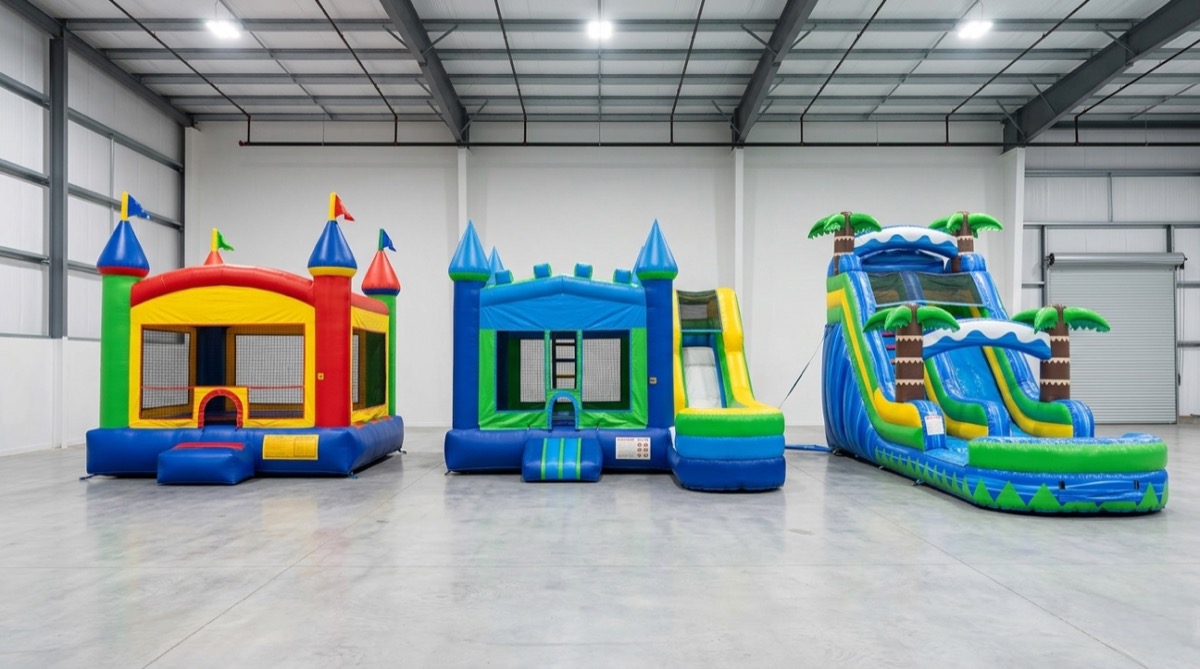
Commercial bounce houses are made from 18oz vinyl — fire-retardant, lead-free, and built to survive hundreds of rentals. They cost $1,500–$5,000 per unit. Residential inflatables ($200–$500) are cheaper, but they tear easily, void your insurance, and create real safety liability. Every insurance provider and venue will require commercial-grade equipment.
What to buy first
Start with two to three versatile units that cover the most common requests:
- Standard 13×13 bounce house — $1,500–$3,000. This is your bread and butter. A JumpOrange 13×13 runs about $1,400–$2,000 at member pricing. Every birthday party wants one.
- Combo unit with slide — $2,000–$4,000. A 5-in-1 combo from manufacturers like JumpOrange or Happy Jump runs $2,000–$3,500. Commands higher rental rates.
- Water slide or obstacle course (optional) — $3,500–$6,000. Seasonal money-maker in warm climates. Skip this on day one unless you’re in Florida or Texas.
New vs. used
Used commercial bounce houses sell for 40-60% of retail. You can find them on Facebook Marketplace, Craigslist, and industry groups for $800–$2,500. Inspect the vinyl carefully — check seams, look for patches, and test the blower. A unit with minor cosmetic wear is fine. A unit with blown seams or mold is not worth any price.
Insurance — the cost you can’t skip
Kids jump. Kids fall. One uninsured injury claim can end your business before it starts.
What you need and what it costs
| Coverage | What It Covers | Annual Cost |
|---|---|---|
| General liability | Bodily injury, property damage at events | $800–$2,500 |
| Product liability | Defects in the equipment itself | Often bundled with general liability |
| Commercial auto | Your vehicle while transporting equipment | $1,200–$3,000 |
| Workers’ comp | Employee injuries (required if you hire) | Varies by state |
According to MoneyGeek, the average bounce house business pays around $70/month ($846/year) for general liability with $1 million in coverage. Rates range from $61 to $82/month depending on your state. If you add workers’ comp, professional liability, and a business owner’s policy, expect a comprehensive package to run around $2,400/year.
The part most new operators miss
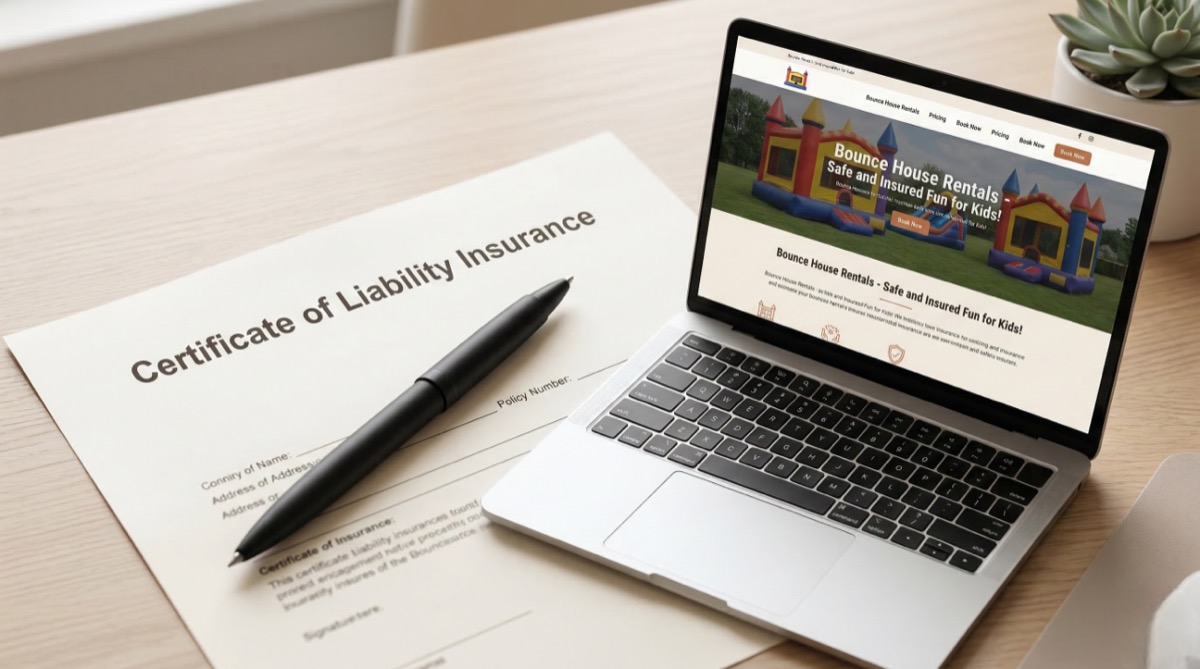
Venues, parks, schools, and churches require proof of insurance before you set up. Most demand $1 million to $2 million in general liability coverage. Some require $5 million. They’ll also ask to be listed as “additional insured” on your certificate.
No insurance means no booking. It’s not just protection — it’s a sales requirement.
Standard business insurance policies typically exclude amusement devices. You need specialized inflatable rental insurance from providers like XINSURANCE, Cossio Insurance, or K&K Insurance.
Ready to manage your bookings and track every rental from day one?
Try LendControl free for 14 days
No credit card required.
Vehicle and delivery setup
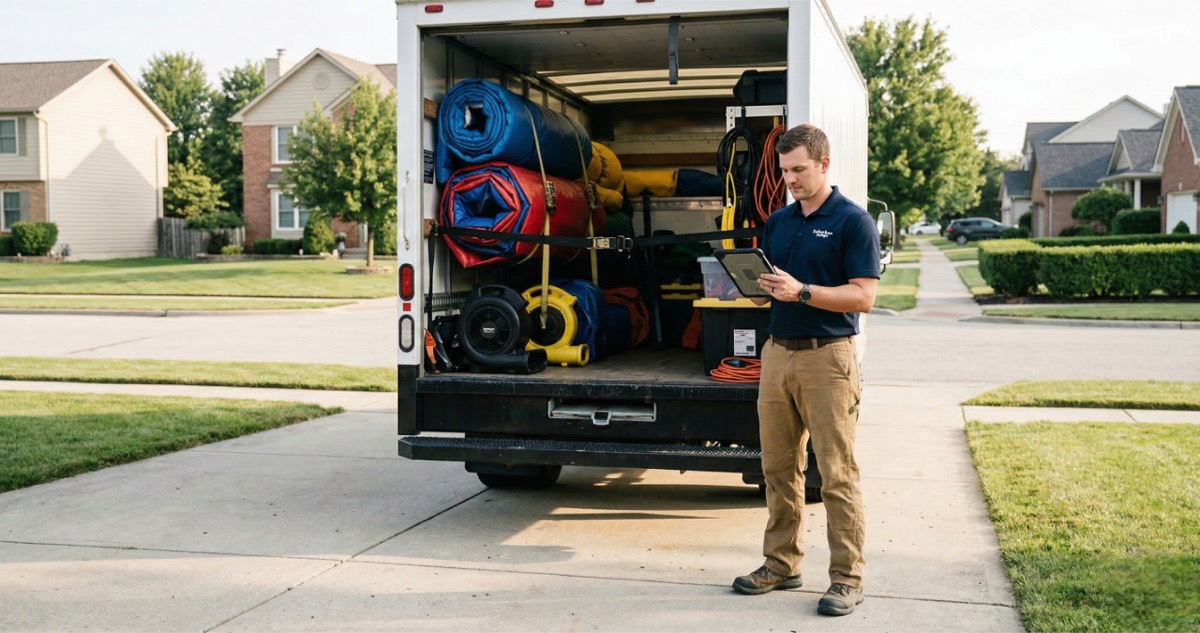
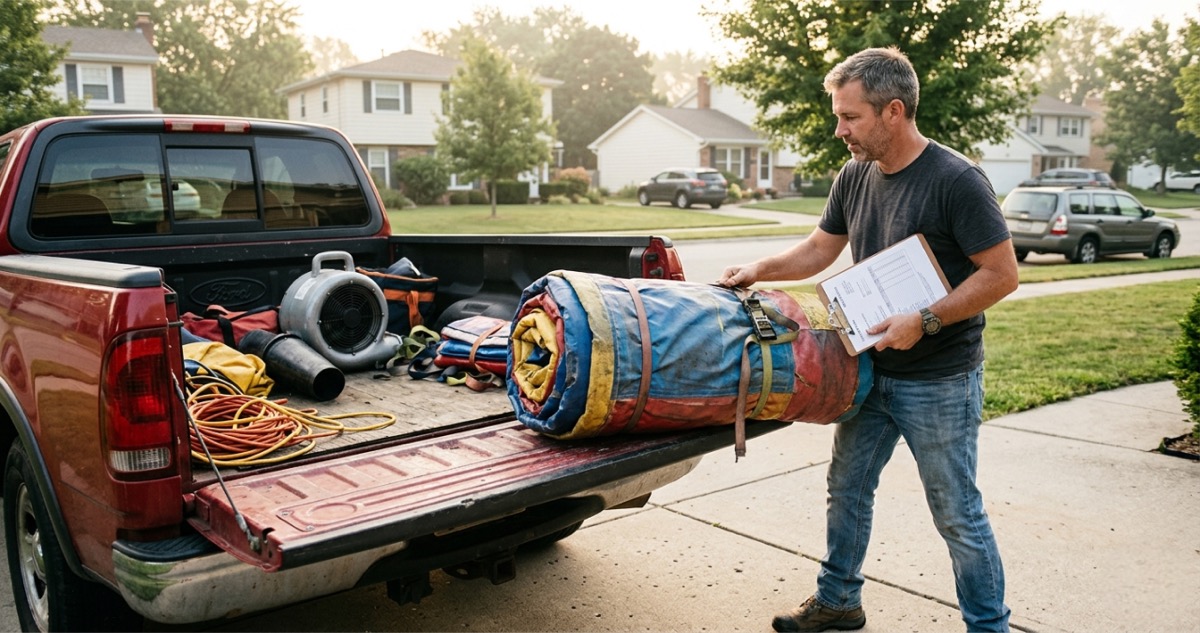
You need a way to get 200-400lb inflatables to the party and back.
Your options
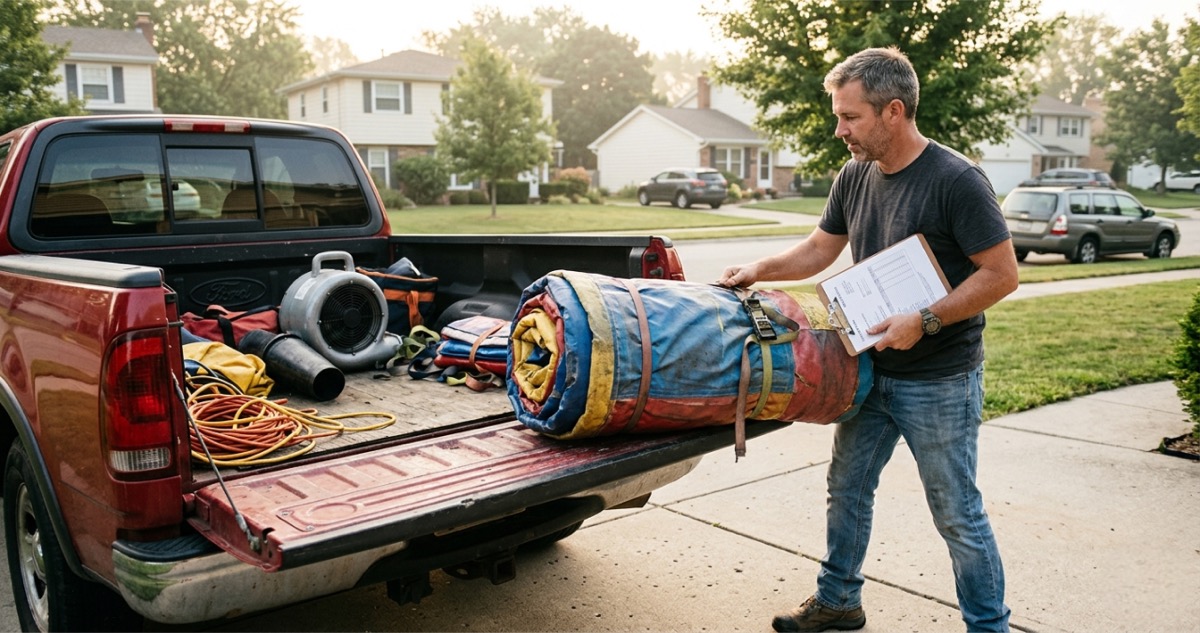
- Pickup truck you already own — $0. Works for 1-2 standard bounce houses. Most operators start here.
- Used cargo van — $3,000–$8,000. Fits 2-3 units and keeps equipment dry during transport.
- Enclosed utility trailer — $1,000–$3,000 used. Tow it with your existing SUV or truck.
- Box truck — $5,000–$15,000 used. For operators with 4+ units. Overkill on day one.
If you already have a truck or SUV, you might only need a basic utility trailer. That keeps this entire line item under $2,000.
Delivery essentials (don’t forget these)
- Heavy-duty dolly — $80–$150
- Ratchet straps — $30–$50
- 100 ft outdoor-rated extension cord — $40–$60
- Moving blankets — $30–$50
These small purchases add up to $200–$400 but save you from damaged equipment and back injuries.
Business registration and legal fees
This is one of the cheapest parts of starting up, but skipping it puts your personal assets at risk.
LLC formation
File through your state’s Secretary of State website. Filing fees range from $40 (Kentucky) to $500 (Massachusetts), with most states falling between $50 and $150. An LLC separates your personal finances from the business — critical when you’re renting equipment that kids jump on.
Business license
Most cities require a general business license, typically $50–$200/year. Some states (New York, Virginia) require additional amusement device permits and inspections. Check your local government website.
Sales tax registration
Rental income is taxable in most states. Register for a sales tax permit (free in most states) so you can collect and remit properly.
EIN and bank account
Get a free EIN from the IRS, then open a business bank account. Keep business and personal money separate from day one. You’ll thank yourself at tax time.
Total legal costs: $100–$800 depending on your state.
Website, software, and marketing
You need customers to find you, book you, and pay you. Here’s what that costs.
Website
A simple one-page site with your inventory, pricing, service area, and a booking form runs $0–$500 to set up. Use a website builder like Squarespace or Wix ($12–$30/month) or a free option through your bounce house rental software provider.
Booking and rental management software
Rental software keeps your availability updated in real time, handles online bookings, sends invoices, and prevents double-bookings. Plans typically run $25–$100/month depending on features.
This isn’t optional once you have more than one unit. The moment two families show up expecting the same bounce house on the same Saturday, you’ll wish you had a system. Inflatable rental software pays for itself with the first double-booking it prevents.
Marketing (first 3 months)
- Google Business Profile — free. This is your single most important marketing move. When someone searches “bounce house rental near me,” Google shows the local map pack first. Claim it, fill it out, add photos.
- Business cards and flyers — $100–$200 for 500+ prints
- Facebook and Instagram ads — $10–$20/day targeted to local parents. Budget $300–$600 for your first 3 months.
- Yard signs — $50–$150 for a set of branded signs to place at event locations (with permission)
- Vehicle decal or magnet — $100–$300. Every delivery becomes a moving billboard.
Total marketing budget (first 3 months): $200–$2,000 depending on how aggressively you want to grow.
The accessories nobody budgets for
These are the line items that surprise first-time operators. They’re small individually but add up fast:
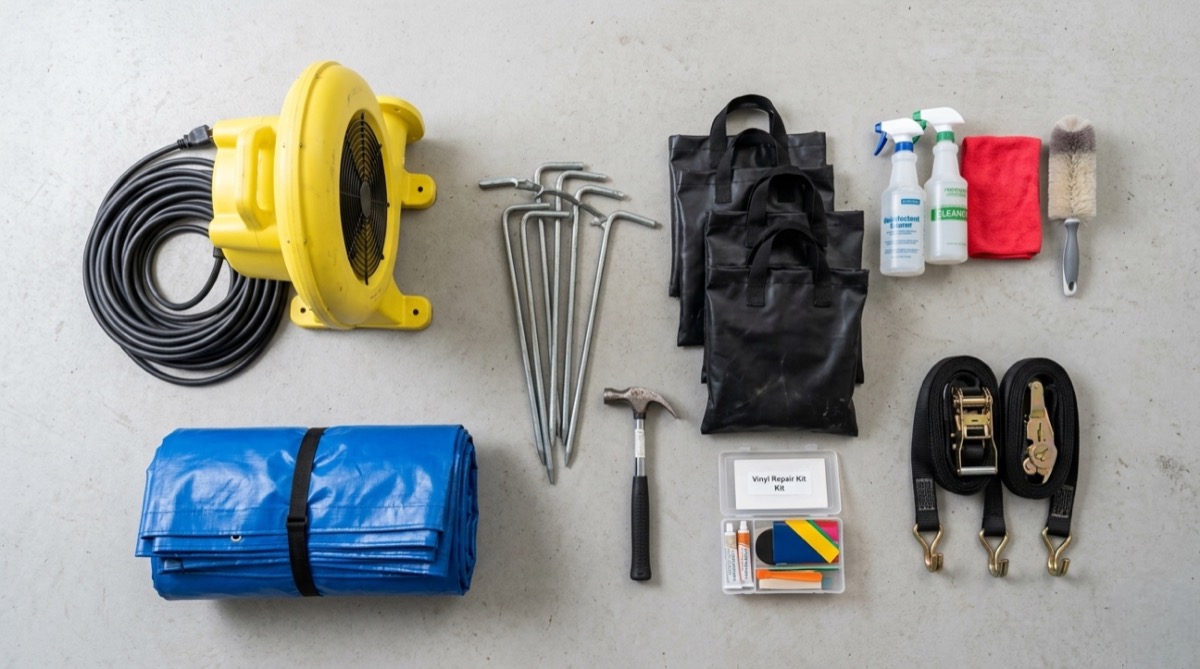
- Blowers — $100–$300 each. Every bounce house needs one, and you should own a backup. Budget $200–$600 for 2-3 blowers.
- Ground stakes — $20–$40 per set. Required for grass setups. Buy extras.
- Sandbags — $30–$60 per set. Required for concrete or asphalt setups where you can’t use stakes.
- Tarps — $20–$80 each. Place under every bounce house to protect the vinyl from rough surfaces and moisture.
- Vinyl repair kit — $15–$30. Patch small tears on-site instead of losing a full day’s rental.
- Cleaning supplies — $30–$50. Disinfectant spray, towels, and a shop vac.
- Generator (optional) — $300–$800. For venues without outdoor power access. Or rent one per event for $50–$100.
Total accessories budget: $300–$1,200.
How fast can you make this money back?
The math works in your favor if you’re consistent.
A standard 13×13 bounce house rents for $150–$350/day depending on your market. Combo units command $200–$450/day. If you rent a single unit 4-6 times per month, that’s $600–$2,100 in monthly revenue from one bounce house.
Here’s a simple payback scenario:
| Scenario | Investment | Monthly Revenue | Payback Period |
|---|---|---|---|
| 2 units, lean start | $5,000–$8,000 | $1,200–$3,000 | 2-4 months |
| 3 units, full setup | $13,000–$20,000 | $2,000–$5,000 | 3-6 months |
After your initial investment is paid off, your ongoing monthly costs (insurance, storage, gas, software) run $400–$800/month. Everything above that is profit.
The operators who recover their bounce house rental startup cost fastest are the ones who book consistently, price fairly, and don’t lose bookings to disorganization. A missed booking because you forgot who had the combo unit on Saturday costs you $200–$400 in lost revenue every time.
That’s why setting up your operations — bounce house rental software, insurance, legal structure — before your first booking matters more than buying a fourth bounce house.
Frequently asked questions
How much does it cost to start a bounce house rental business?
Most operators launch for $5,000–$15,000. That covers 2-3 commercial-grade bounce houses, general liability insurance, business registration, a basic website, and essential accessories. If you already own a truck, you can start closer to the $5,000 end. Adding a used vehicle or trailer pushes total startup costs toward $15,000–$20,000.
Can I start a bounce house business with just one unit?
Yes, but two is better. One bounce house limits you to one booking per day, and you have zero backup if it needs repair. Starting with a standard 13×13 and one combo unit covers most party requests and lets you book two events on the same day. Your second unit usually pays for itself within 2-3 months.
What is the most expensive part of starting a bounce house business?
The inflatables themselves. Two to three commercial-grade units run $3,000–$12,000 depending on whether you buy new or used. Insurance is the second-largest cost at $800–$2,500/year. Everything else — legal fees, marketing, accessories — is relatively small by comparison.
Do I need a special vehicle to deliver bounce houses?
Not necessarily. A standard pickup truck handles 1-2 deflated bounce houses. A deflated 13×13 bounce house weighs 200-300 lbs and folds down to roughly the size of a large duffel bag. As you add units, you’ll want a cargo van or enclosed trailer. Most operators start with whatever vehicle they already own and upgrade later.
Is bounce house rental seasonal?
In most markets, spring through fall is peak season, with summer weekends being the busiest. You can extend revenue into winter by offering indoor setups for churches, gyms, and community centers. Water slides and wet units are summer-only in most climates. Expect 60-70% of your annual revenue to come from May through September.