
Most bounce house rental operators set their prices by copying the competition and hoping for the best. That works until you realize you’re barely covering gas money after insurance, maintenance, and delivery costs eat into every booking.
Getting bounce house rental pricing right is the difference between a business that scales and one that stalls out after a season.
- Price too low — you’re working weekends for free
- Price too high — your phone stops ringing
This guide breaks down real pricing data, cost-based formulas, and seasonal strategies so you can set rates that actually make money — and adjust them as your bounce house rental business grows.
Know your real costs before you set a single price
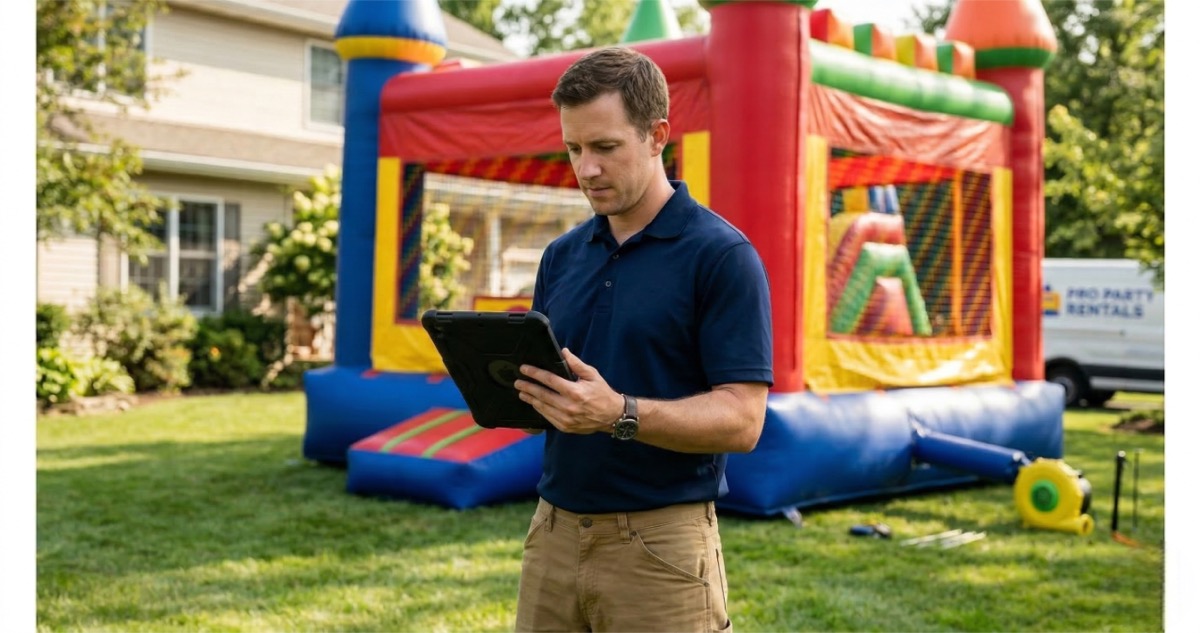
You can’t price profitably if you don’t know what each rental actually costs you. Most new operators only think about the purchase price of the bounce house. The real cost per rental includes everything it takes to get that unit to a party and back.
Here’s what goes into a single rental:
| Cost Category | Estimated Per-Rental Cost |
|---|---|
| Equipment depreciation (unit lifespan: 3-5 years) | $15–$30 |
| Insurance (allocated per rental) | $8–$15 |
| Gas and vehicle wear | $15–$40 |
| Cleaning and maintenance | $10–$20 |
| Your labor (delivery, setup, pickup: 2-3 hours) | $30–$75 |
| Storage (allocated per rental) | $5–$10 |
| Total cost per rental | $83–$190 |
If you’re charging $150 for a standard bounce house and your per-rental costs run $120, you’re making $30 for three hours of physical labor. That’s not a business — that’s a side hustle that’s slowly breaking your truck.
The formula is simple: add up your true per-rental cost, then mark up 40-60% to cover overhead and profit. A unit that costs you $100 per rental should rent for $160–$250, depending on your market.
What bounce house operators actually charge in 2026
Here’s what the market looks like right now. These are real rates from operators across the U.S., not wishful thinking.
Standard rental rates by unit type
| Unit Type | 4-6 Hour Rental | Full Day (8+ Hours) |
|---|---|---|
| Standard 13×13 bounce house | $150–$250 | $200–$350 |
| Combo unit (bounce + slide) | $225–$350 | $300–$450 |
| Themed bounce house (princess, superhero) | $185–$300 | $250–$400 |
| Water slide | $250–$400 | $350–$575 |
| Obstacle course | $300–$500 | $400–$600 |
How location affects pricing
Where you operate changes what you can charge — significantly.
- Major metro areas (Los Angeles, Dallas, Atlanta, Miami): Rates push toward the top of every range. A standard 13×13 in a metro market rents for $200–$300 per day.
- Mid-sized cities: $150–$250 is the sweet spot for most operators.
- Rural and small-town markets: $100–$175 is common. Customers are more price-sensitive, but your delivery radius is usually wider.
The lesson: don’t copy prices from an operator in a different market. A $275 rate that works in Houston might kill your bookings in a small town in Ohio.
Build your bounce house rental pricing structure
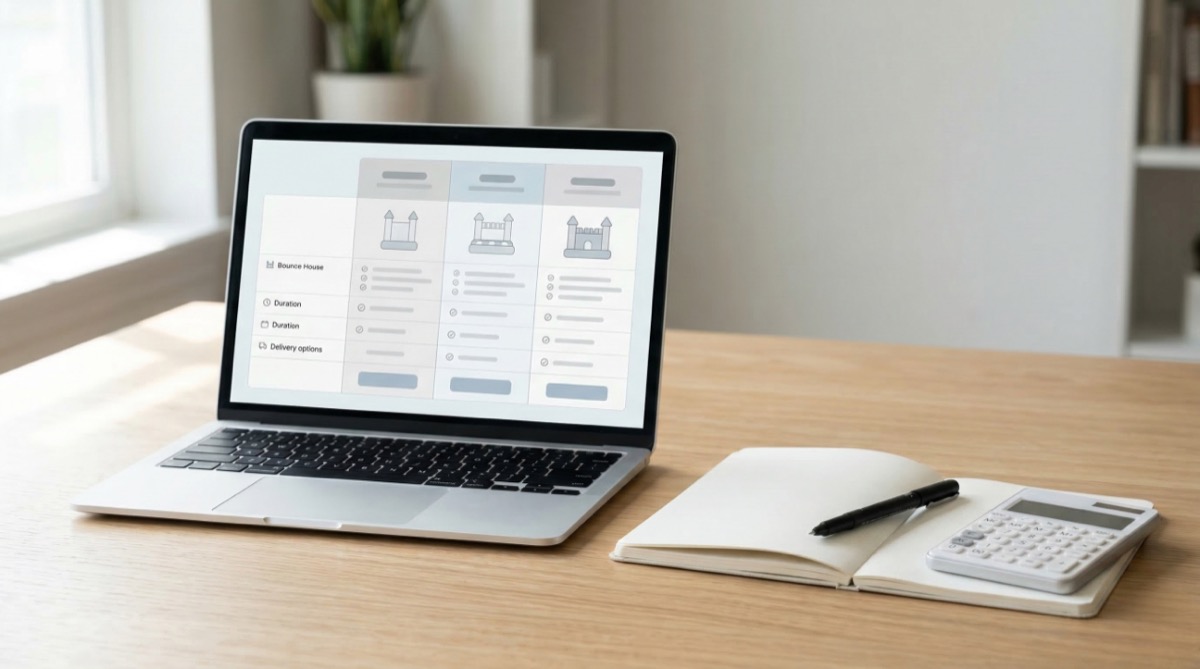
There are three common pricing models. Most successful operators use a combination.
Daily flat rate (most common)
Charge one price for a set rental window — typically 4-8 hours. This is the simplest model and what most customers expect for birthday parties and backyard events.
Best for: Birthday parties, weekend rentals, residential events.
Hourly rate
Charge $30–$50 per hour. This works for shorter events like school fairs, church festivals, or corporate team-building days where the client only needs the unit for 2-3 hours.
Best for: Short events, community fairs, weekday corporate bookings.
Package pricing
Bundle multiple units together at a slight discount. A common package: two bounce houses plus a water slide for $600–$800 instead of $750–$1,000 if rented individually. You make slightly less per unit but book more inventory in a single trip.
Best for: Large events, festivals, customers with bigger budgets.
The “Rule of Ten” pricing formula
Here’s a quick starting point used by many operators: take what you paid for the unit and divide by ten. A $3,000 bounce house rents for around $300. A $2,000 unit rents for $200.
This rule gets you in the ballpark. Then adjust based on your local competition, your per-rental costs, and demand. It’s a starting point — not a ceiling.
Ready to send professional quotes in minutes instead of hours?
Try LendControl free for 14 days
No credit card required.
Use seasonal and weekend pricing to protect your margins
If you charge the same rate in July as you do in January, you’re leaving money on the table during peak season and struggling to fill your calendar during the slow months.
Peak season (May through September)
This is when 70-80% of your annual revenue happens. Birthday parties, school year-end events, graduation celebrations, Fourth of July festivals — everyone wants a bounce house.
What to do: Charge your full standard rates. No discounts on weekends. Consider raising prices 15-25% for premium summer weekends (Memorial Day, Fourth of July, Labor Day). Your calendar should be filling up — if it’s not, the issue is marketing, not pricing.
Shoulder season (March-April, October-November)
Demand drops but doesn’t disappear. Fall festivals, Halloween events, and spring school fairs keep some bookings coming in.
What to do: Hold your weekday rates but consider offering 10-15% discounts for weekday bookings to fill gaps in your schedule.
Off-season (December through February)
Outdoor rentals slow to a crawl in most markets. Indoor events — churches, gyms, community centers, indoor sports facilities — become your main revenue source.
What to do: Offer off-season packages at 20-30% below peak rates to keep your inventory working. Market specifically to indoor venues. Some operators offer multi-day indoor rentals at reduced daily rates.
Weekend vs. weekday pricing
Saturday is your highest-demand day. Friday and Sunday are second tier. Monday through Thursday is your slowest window.
A simple structure:
| Day | Pricing Strategy |
|---|---|
| Saturday | Full price — no discounts |
| Friday / Sunday | Full price or 5-10% discount to fill gaps |
| Monday – Thursday | 15-25% discount to drive volume |
Add-on fees that boost revenue without scaring off customers
Your base rental rate is your starting point. Add-ons are where your per-booking revenue grows.
Delivery fees
Most operators include delivery within a 10-15 mile radius. Beyond that, charge $1–$3 per additional mile. Be transparent about this upfront — hidden fees at checkout kill trust and bookings.
Generator rental
Not every backyard has a convenient outdoor outlet. Offer a generator rental for $50–$100 per event. It’s a high-margin add-on that solves a real problem for the customer.
Extended hours
Charge $25–$50 per extra hour beyond your standard rental window. Parties run late. Parents are happy to pay for an extra hour if it means the kids stay entertained.
Setup surface surcharge
Concrete and asphalt setups require sandbags instead of stakes — and more labor. A $25–$50 surcharge for non-grass setups is standard and fair.
Overnight or multi-day rentals
Offer overnight rentals at a 25-50% premium over the day rate. Multi-day rentals (festivals, multi-day events) can be priced at 50% off for each additional day — you keep the revenue flowing without the extra delivery trip.
Stop leaving money on the table with manual quotes
You can have the best pricing structure in your market, but if it takes you 20 minutes to build a quote for every call and text, you’re losing bookings to operators who respond faster. A customer texts three companies asking about Saturday — the first one back with a clear price and a booking link wins.
This is exactly what bounce house rental software solves. With LendControl, you set your pricing rules once and the system handles the rest:
- Seasonal rates adjust without manual updates
- Customers get instant quotes through your online booking page — no back-and-forth
The operators who grow past 5-10 units aren’t pricing manually. They’re using inflatable rental software to handle the math so they can focus on delivering great service and booking more events.
Frequently asked questions
How much should I charge for a bounce house rental?
Most operators charge $150–$350 per day for a standard 13×13 bounce house, depending on the market. Metro areas command higher rates ($200–$300+), while smaller markets sit closer to $150–$200. Start by calculating your per-rental cost and marking up 40-60% to ensure you’re profitable on every booking.
How do I calculate profit margin on bounce house rentals?
Add up all costs for a single rental — equipment depreciation, insurance, fuel, labor, cleaning, and storage. Subtract that from your rental price. Healthy bounce house rental businesses target a 30-40% profit margin after all expenses. If you’re below 20%, your prices are too low or your costs need trimming.
Should I offer hourly or daily pricing for bounce house rentals?
Most residential customers (birthday parties, family events) prefer daily flat rates — it’s simple and predictable. Hourly pricing ($30–$50/hour) works better for commercial clients, school events, and shorter community fairs. Many operators offer both and let the customer choose what fits their event.
How much should I charge for bounce house delivery?
Include delivery free within a 10-15 mile radius from your base, then charge $1–$3 per additional mile. This is standard across the industry. Be upfront about delivery fees during the quoting process — surprising customers with fees at checkout leads to cancellations and bad reviews.
When should I raise my bounce house rental prices?
Raise prices when you’re consistently booked 80%+ on weekends during peak season. If every Saturday is full two weeks in advance, the market is telling you there’s room to charge more. Increase by 10-15% and monitor booking volume. Also raise prices annually to keep pace with rising insurance, fuel, and maintenance costs.
Set your prices, protect your margins, and grow
Your bounce house rental pricing isn’t a set-it-and-forget-it decision. Your rates should reflect your real costs, your local market, and the season. Start with the cost-based formula, study what competitors charge in your area, and build in room for profit — not just revenue.
The operators who build profitable bounce house rental businesses aren’t the cheapest in their market. They’re the ones who know their numbers, price with confidence, and use the right tools to send quotes fast and close bookings before the competition.
Ready to automate your pricing and close bookings faster?
No credit card required.