
You have the idea. Maybe you already own a mini excavator or a pressure washer collection. But before you rent your first piece of equipment, you need to know the real numbers — not vague “it depends” advice.
This guide breaks down every cost category with source-backed numbers so you can plan your equipment rental startup cost accurately — whether you’re launching from a garage or a warehouse.
How much does it cost to start an equipment rental business?
The short answer: $5,000 to $200,000+, depending on your scale and equipment type.
A home-based rental business startup focused on power tools and small landscaping equipment can get off the ground for $5,000-$15,000. A mid-size commercial operation with a warehouse and heavier equipment pushes that range to $60,000-$200,000. And if you’re looking at heavy construction equipment like excavators and skid steers, you could be looking at $150,000-$300,000+ to get started.
The equipment rental startup cost depends on three things:
- What you rent — power tools vs. heavy machinery
- How much you stock — starter fleet vs. full inventory
- Whether you buy new or used — 30-50% savings on used equipment
The rest of your costs — insurance, storage, software, marketing — are relatively predictable. Here is every category broken down with real numbers.
Equipment costs — your biggest line item
Equipment is where most of your startup budget goes. It’s also where smart buying decisions save you thousands.
Small equipment and power tools
If you’re starting small, power tools and handheld equipment have the lowest barrier to entry.
- Demolition hammers, planers, orbital sanders: $150-$500 per tool, ROI in 15-25 rentals (Booqable)
- Landscaping equipment (tillers, aerators): $500-$2,500 per unit, ROI in 12-20 rentals
- Starter fleet of 10-15 tools: roughly $3,000-$10,000
Mid-range equipment
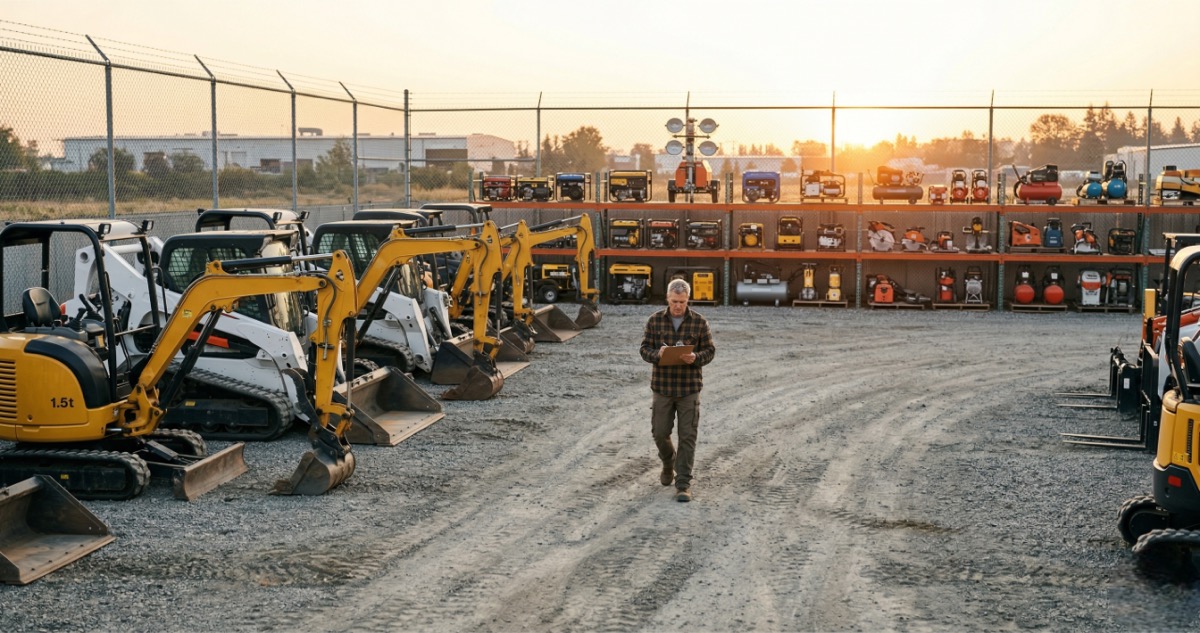
Pressure washers, generators, concrete mixers, and light compaction equipment fall in the $1,000-$5,000 range per unit. A solid mid-range inventory of 8-12 pieces runs $15,000-$50,000.
Heavy construction equipment
This is where costs jump significantly.
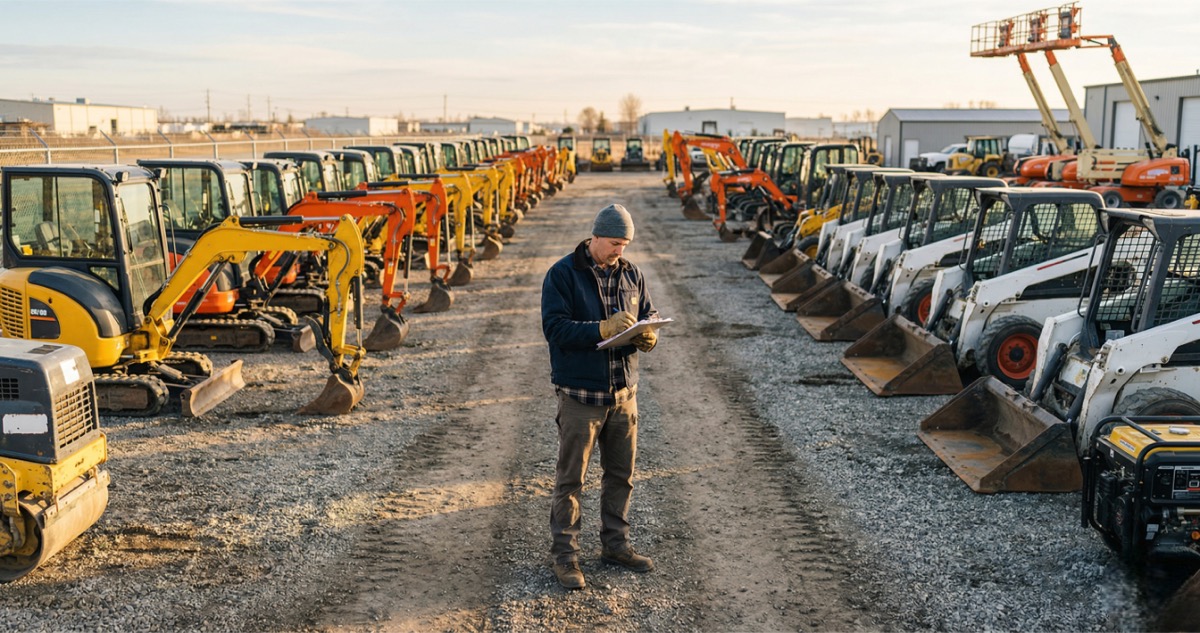
- Used mini excavators: average around $47,500 (Equipment World)
- Skid steer loaders, boom lifts, trenchers: $20,000-$80,000 used
- Foundational heavy fleet (3-5 machines): $50,000-$150,000 (Wexford Insurance)
New vs. used
Buying used saves 30-50% on most equipment. For a rental business startup, used equipment in good condition is the smarter play — your customers care whether it works, not whether it’s brand new. Check Equipment Trader, MachineryTrader, and local auctions for deals.

Storage and warehouse costs
You need somewhere to store, maintain, and stage your equipment. Your options range from your own garage to a commercial warehouse.
- Home-based (garage/yard): $0 out of pocket, but limited by space and local zoning. Works for small tool rental operations with 10-20 items.
- Self-storage units: A 10×20 unit runs $100-$300/month. Good for small inventory, but not practical for heavy equipment or customer pickups.
- Commercial warehouse space: National average is approximately $9.00 per square foot annually (Red Stag Fulfillment). A 1,500-3,000 sq. ft. space costs $2,000-$5,000/month (Wexford Insurance).
Costs vary dramatically by region. Secondary markets in the Midwest run $6-$8/sq. ft. annually, while Los Angeles and Northern New Jersey push $16-$22/sq. ft. (ReadySpaces).
Want to track your rental equipment without the spreadsheet headaches? Try LendControl free — no credit card required.
Vehicle and trailer costs
Unless every customer picks up their own equipment, you need a way to deliver. Most equipment rental businesses need at least one truck and trailer combination.
- Pickup truck (used): A work-ready used pickup (F-250, Ram 2500, or similar) runs $15,000-$30,000 depending on age and mileage.
- Flatbed or utility trailer: New utility trailers with 7,000 lb. capacity cost $3,000-$7,000. Heavy-duty flatbed trailers with 14,000 lb. capacity run $7,000-$15,000. Used trailers are 30-40% less.
- Box truck (used): For tool-heavy operations with lots of smaller items, a used box truck costs $15,000-$25,000.
For a small operation, budget $18,000-$40,000 for a used truck and trailer. If you already own a suitable truck, your delivery costs drop to just the trailer.
Insurance you actually need
Equipment rental insurance is not optional — it protects you from claims that could shut down your business before it gets going. Here are the policies you need:
- General liability insurance: Covers third-party injuries and property damage. Costs $480-$660/year for basic coverage, or $5,000-$10,000/year for a $1-$2 million policy needed for commercial equipment rental businesses (Insureon, Wexford Insurance).
- Inland marine insurance: Covers your equipment against theft, damage, and loss — whether it’s on your lot or at a customer’s job site. Costs roughly $175-$450/year (Simply Business).
- Commercial auto insurance: Covers your delivery vehicles. Average cost for contractors is $272/month or roughly $3,264/year (Progressive Commercial).
- Workers’ compensation: Required if you have employees. Costs $360-$720/year for a small team of 3-5 people (eSports Insurance).
Total insurance budget for a small-to-mid equipment rental business: $4,000-$14,000/year.
Business registration and legal fees
Getting your rental business startup legally set up is one of the cheaper parts of the process.
- LLC formation: Filing fees range from $35-$500 depending on your state. Montana is the cheapest at $35, while Massachusetts charges $500 (LLC University).
- Business license and permits: Varies by city and state. Budget $50-$400 for local business licenses.
- EIN (Employer Identification Number): Free from the IRS.
- Operating agreement (if using a lawyer): $1,000-$1,500 for professional drafting, though many small business owners handle this themselves (Nolo).
- Annual report/renewal fees: Most states charge $50-$300/year to keep your LLC in good standing.
Total legal and registration costs: $200-$2,500 in year one.
Software, website, and marketing
Rental management software
Spreadsheets work for the first month. After that, you need equipment rental software to track inventory, manage bookings, and handle payments. Options range from $29/month (Booqable) to $500/month (Quipli) (Booqable, Capterra). LendControl offers a 14-day free trial with no credit card required.
Budget $350-$6,000/year for rental software depending on the platform.
Website
A professional website with online booking capability costs $1,500-$5,000 for initial setup. DIY website builders like Squarespace or Wix can cut that to $200-$500/year if you build it yourself.
Marketing
Initial marketing — Google Business Profile setup, local SEO, business cards, yard signs, and basic paid ads — runs $2,000-$10,000 in the first year (BusinessPlan Templates). Many small operators start with a $500-$1,000 budget and reinvest as revenue comes in.
Total software, website, and marketing: $2,500-$15,000 in year one.
Full equipment rental startup cost table
Here is every major cost category side by side, comparing a small home-based operation against a mid-size warehouse operation.
| Cost Category | Small / Home-Based | Mid-Size Warehouse |
|---|---|---|
| Equipment inventory | $3,000-$15,000 | $50,000-$150,000 |
| Storage / warehouse | $0 (home) | $24,000-$60,000/yr |
| Vehicle + trailer | $3,000-$7,000 (trailer only) | $18,000-$40,000 |
| Insurance (year 1) | $1,500-$4,000 | $5,000-$14,000 |
| Legal / registration | $200-$500 | $500-$2,500 |
| Software (year 1) | $350-$1,200 | $1,200-$6,000 |
| Website | $200-$500 | $1,500-$5,000 |
| Marketing (year 1) | $500-$2,000 | $2,000-$10,000 |
| Total estimated startup | $5,000-$30,000 | $100,000-$285,000 |
Sources: Wexford Insurance, LLC University
These numbers reflect real cost ranges as of 2025-2026. Your actual equipment rental startup cost depends on your market, equipment type, and whether you buy new or used.
Frequently asked questions
How much does it cost to start an equipment rental business from home?
A home-based equipment rental business focused on power tools and small landscaping equipment can start for $5,000-$15,000. That covers a starter inventory, trailer, basic insurance, and business registration. You skip warehouse costs entirely by operating out of your garage.
What is the most profitable equipment to rent out?
Equipment with the fastest return on investment includes pressure washers, concrete mixers, power tools, and mini excavators. Smaller tools ($150-$500) can pay for themselves in 15-25 rentals (Booqable). Mini excavators command $250-$500/day in rental fees, making them high earners despite the higher upfront cost.
Do I need a commercial space for an equipment rental business?
Not necessarily. Many operators start from home and move to a commercial space once revenue supports it. Check your local zoning laws first — some residential areas restrict commercial activity. Once you’re handling heavy equipment or regular customer pickups, a warehouse with yard space becomes a practical necessity.
What insurance do I need for an equipment rental business?
At minimum, you need general liability insurance and inland marine insurance (which covers your equipment off-premises). If you deliver, add commercial auto insurance. If you hire employees, workers’ compensation is required in most states. Budget $4,000-$14,000/year total depending on your coverage levels and fleet size.
Can I start an equipment rental business with no money?
Realistically, no. Even the leanest operation needs a few thousand dollars for equipment, insurance, and legal setup. Some operators reduce upfront costs by purchasing one or two pieces of equipment and reinvesting rental income into additional inventory. Equipment financing and SBA microloans are options if you have limited cash but strong credit.
Your equipment rental startup cost comes down to your starting point
The gap between a $5,000 startup and a $200,000 startup is not about ambition — it’s about strategy. Plenty of successful equipment rental businesses started with a pressure washer, a trailer, and a phone that wouldn’t stop ringing.
Start with equipment you know. Buy used where it makes sense. Keep your overhead low in year one. And put a system in place early to track your inventory, bookings, and customers — so you’re not buried in spreadsheets by month three.
The equipment rental startup cost is real, but the margins are strong once you’re operational. The operators who struggle are not the ones who started small — they’re the ones who started disorganized.
Get Started for Free — No credit card required.