Most equipment rental businesses leave money on the table — not because they charge too little, but because they guess instead of calculate.
- Pricing based on “what feels right” — almost certainly undercharging on some items
- Copying the competitor down the road — their costs aren’t your costs
- No formula behind the rates — bleeding margin on every booking
Getting equipment rental pricing right is the difference between a business that grows and one that bleeds margin on every booking.
Why most equipment rental pricing is broken
The U.S. equipment rental industry hit roughly $80.5 billion in revenue in 2025, with the American Rental Association projecting growth to $82.3 billion in 2026. There is no shortage of demand. The problem is how individual operators price their gear.
Here is what usually goes wrong:
- Copying national chains. United Rentals and Sunbelt operate at a scale that lets them absorb thin margins. You cannot. Their rates are a reference point, not your pricing strategy.
- Ignoring total cost of ownership. You bought a mini excavator for $40,000 but forgot to factor in insurance, maintenance, transport, and storage. Your daily rate does not cover the real cost of putting that machine on a job site.
- Flat pricing year-round. Charging the same rate in January (when equipment sits idle) as you do in June (when everything is booked) leaves profit on the table during peak season and kills utilization during the slow months.
Good equipment rental pricing starts with knowing your actual costs, benchmarking against real market data, and building a rate structure that rewards longer rentals without giving away your margin.
The equipment rental pricing formula that actually works
The most referenced rule in the equipment rental business is the 1-2% rule: your daily rental rate should be 1% to 2% of the equipment’s market value. A $25,000 skid steer would rent for $200-$500/day under this model.
That rule is a starting point, not the answer. Here is a more complete formula:
Annual rental revenue target = Equipment cost x 5% per month x 13 months x 80% utilization
This generates a 35-40% gross profit margin — which is realistic for a well-run rental operation.
Breaking it down step by step
- Start with your total equipment cost. Include purchase price, sales tax, and any upfront modifications.
- Add annual operating costs. Insurance, maintenance, repairs, storage, and licensing. A common benchmark is 20% of purchase price annually for operating costs.
- Set your target utilization rate. Most rental businesses aim for 60-80%. Below 60%, your equipment sits too much. Above 80%, you are probably turning away bookings.
- Add your profit margin. Industry profit margins range from 10% to 50%, depending on equipment type and local competition.
- Divide by your annual rental days. This gives you your daily rate.
Example: You buy a mini excavator for $40,000. Annual operating costs are $8,000 (20%). You want a 30% profit margin and expect 200 rental days per year.
- Total annual cost: $48,000
- With 30% margin: $62,400
- Daily rate: $62,400 / 200 = $312/day
That lines up with real market data, which we will look at next.

Real equipment rental rates by category
Here is what the market actually charges. Use these as benchmarks — your local rates will vary based on competition, demand, and geography.
Heavy equipment
| Equipment | Daily Rate | Weekly Rate | Monthly Rate |
|---|---|---|---|
| Mini excavator (small) | $150–$300 | $700–$1,200 | $1,800–$3,000 |
| Mini excavator (mid) | $300–$575 | $1,000–$1,550 | $2,500–$3,675 |
| Skid steer | $200–$500 | $600–$1,900 | $1,500–$5,000 |
Generators
| Equipment | Daily Rate | Weekly Rate | Monthly Rate |
|---|---|---|---|
| Portable (1,000–10,000W) | $50–$200 | $300–$800 | $1,000–$2,500 |
| Towable (10,000–50,000W) | $200–$800 | $600–$2,000 | $2,000–$5,000 |
Smaller equipment and tools
| Equipment | Daily Rate | Weekly Rate | Monthly Rate |
|---|---|---|---|
| Pressure washer (electric) | $33–$47 | $188 | $564 |
| Pressure washer (gas, 3500+ PSI) | $71–$102 | $408 | $1,224 |
| Scaffolding (basic) | $20–$50 | $100–$200 | $300–$600 |
Notice the pattern: weekly rates are roughly 3x the daily rate, and monthly rates are roughly 3x the weekly rate. That is the industry standard multiplier, and it gives customers a real discount for longer commitments while protecting your revenue.
Want to stop guessing on pricing and start tracking every booking in one place?
No credit card required.
Set your daily, weekly, and monthly rate structure
The standard rate multiplier in the equipment rental business works like this:
- Daily rate = your base rate
- Weekly rate = 3x daily rate (customer gets 7 days for the price of 3)
- Monthly rate = 3x weekly rate (customer gets 4 weeks for the price of ~9 days)
This structure is used by national chains and independent operators alike. It works because it incentivizes longer rentals — which means fewer pickups, fewer deliveries, and more predictable revenue for you.
When to adjust the multiplier
- High-demand equipment (mini excavators in summer): Tighten the weekly multiplier to 3.5x daily. Customers still get a discount, but you capture more revenue during peak.
- Specialty or low-utilization items (scaffolding, concrete saws): Offer steeper monthly discounts (2.5x weekly) to boost utilization rates.
- New equipment: Price slightly above market to recover your investment faster while the machine is newest and most reliable.
Track your utilization rate for each piece of equipment. If something rents less than 50% of available days, your price may be too high — or you are not marketing it enough. If it is booked at 90%+, you have room to raise rates.
Add delivery fees, damage waivers, and extras
Your rental rate is just the starting point. The add-ons are where many operators either leave money on the table or nickel-and-dime customers into bad reviews. Get this right.
Delivery and pickup fees
For heavy equipment, delivery is not optional — it is a cost center you need to cover. Common structures:
- Flat fee within a service radius. Example: $150 for delivery and pickup within 25 miles.
- Mileage-based fee. Typically $3-$5 per mile beyond your base radius.
- Free delivery on longer rentals. Some operators waive delivery fees on weekly or monthly bookings to encourage longer commitments.
A good target is for delivery charges to make up 4-5% of your total rental revenue across all bookings.
Damage waivers and protection plans
Damage waivers are typically priced at 10-15% of the rental rate. So a $300/day excavator rental would include an optional $30-$45/day damage waiver.
Making damage waivers optional but clearly communicated protects you in two ways:
- Customers who opt in generate extra margin
- Customers who decline accept liability for repairs — which you should spell out in your rental agreement and invoicing
Fuel charges
Charge for fuel only if equipment is returned below the level it was rented at. A “full-to-full” policy is the cleanest approach — rent it full, return it full, no surprises.
Use seasonal pricing to protect your margins
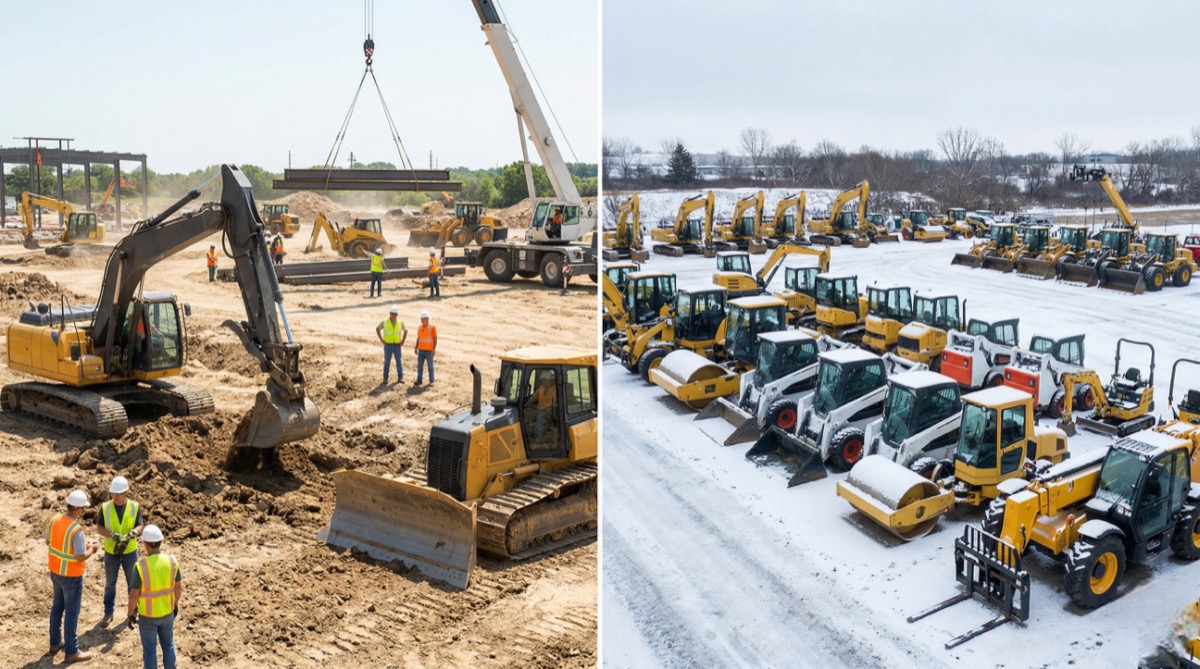
Construction and outdoor work drive the equipment rental cycle. Spring and summer are peak. Winter is slow. Your pricing should reflect that.
How to apply seasonal multipliers
- Peak season (April-September): Apply a 10-15% premium on high-demand categories. A skid steer at $350/day base becomes $385-$400/day. According to Gethapn, reducing rates by 15-25% in the off-season can maintain utilization — which means you should be pricing higher in-season to offset those dips.
- Off-season (October-March): Drop rates 15-20% on underutilized equipment. An idle excavator earning $250/day beats an idle excavator earning $0/day.
- Event-driven spikes: Natural disasters, local construction booms, or large municipal projects can spike demand for generators, pumps, and earthmoving equipment. Monitor local conditions and adjust weekly if needed.
The key is tracking what rents and when. If you manage your equipment rental business with software that shows utilization by item and time period, seasonal adjustments become straightforward. If you are tracking bookings in a spreadsheet, you are making seasonal decisions on gut feel — and that costs money.
Frequently asked questions
How much should I charge per day for equipment rentals?
A common starting point is 1-2% of the equipment’s market value per day. A $30,000 machine would rent for $300-$600/day. But your actual rate depends on local competition, operating costs, and demand. Use the full cost-recovery formula — not just the percentage rule — to make sure your rate covers depreciation, maintenance, insurance, and profit.
What is the standard weekly-to-daily rate multiplier?
The industry standard is 3x: a weekly rate equals three times the daily rate. So a $400/day excavator rents for roughly $1,200/week. Monthly rates are typically 3x the weekly rate. This gives customers a meaningful discount on longer rentals while keeping your revenue predictable.
Should I charge for delivery separately or include it in the rental rate?
Charge separately. Baking delivery into the rental rate penalizes local customers and makes your daily rate look higher than competitors. A flat fee within your service area (e.g., $100-$200 within 25 miles) plus a per-mile charge beyond that is the most common approach.
How do I know if my equipment rental rates are too high or too low?
Track your utilization rate. If a piece of equipment rents less than 50% of available days, you may be priced too high — or you need better marketing. If it is booked solid at 90%+, you likely have room to raise your rate. Aim for 60-80% utilization as a healthy target.
Is a damage waiver worth offering?
Yes. Damage waivers priced at 10-15% of the rental rate are pure margin when nothing goes wrong, and they protect your equipment investment when something does. Make them optional but clearly explained in your rental agreement. Most commercial renters will opt in.
Price your equipment rentals with confidence
Equipment rental pricing is not a one-time decision. It is a system you build and adjust based on real data — your costs, your utilization rates, your local market, and the season. Start with the cost-recovery formula, benchmark against the market rates in this guide, and build a tiered daily/weekly/monthly structure that rewards longer commitments.
The operators who price well are the ones who track well. If you know exactly what each piece of equipment costs you per day and how often it goes out, every pricing decision gets easier.
Ready to automate your pricing and close bookings faster?
No credit card required.