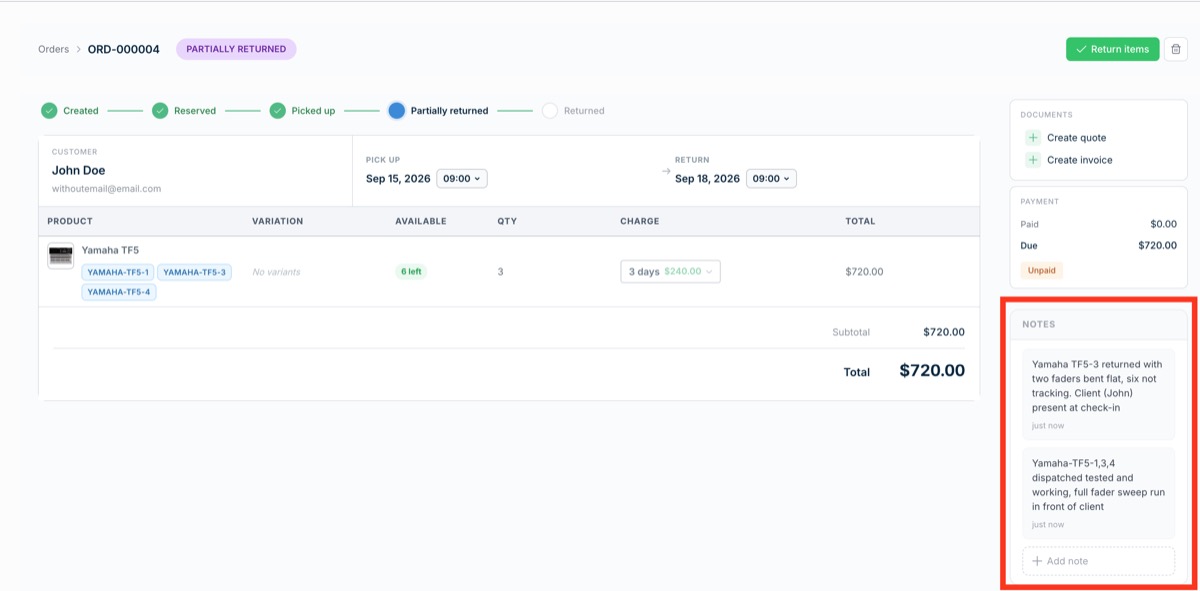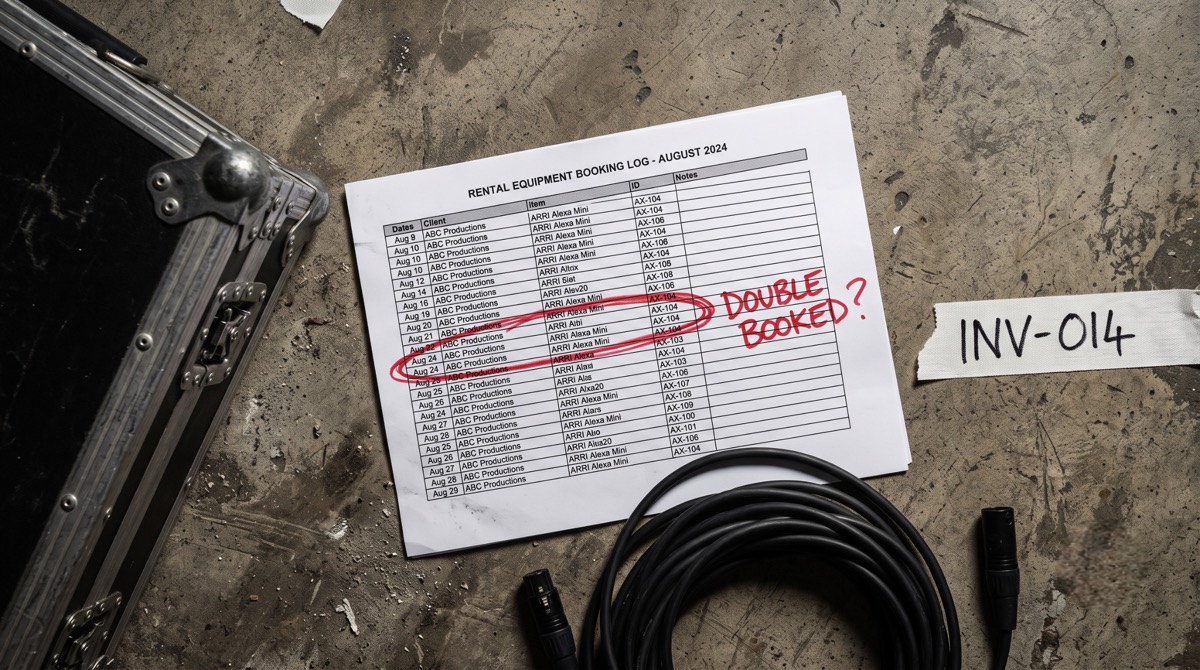

The van comes back at 11pm. Cases go on the shelf unchecked. Deposit is released Monday. Tuesday the next job pulls the console and two faders are bent flat.
Now you’re calling a customer about damage you can’t prove happened on their job. Here’s how to make sure that’s not you, and what to say when it is.
Check it before it hits the shelf
No case goes to storage until it’s been opened, checked and logged. Same night, even at 11pm.
Per case:
Count contents against the pull sheet. Missing cables, PSUs and remotes are the most common “damage” in AV.
Power on anything with a power button.
Check the failure points: faders and encoders on consoles, lens and lamp hours on projectors, connector shells on cables, latches on cases, dead pixels on LED tiles.
Photograph anything different from dispatch, asset tag in frame.
Log condition per item, not per booking.
If the customer is there, do it in front of them. If not, note the time and who checked it.
Anything damaged or missing: mark the deposit as held before the booking moves to Returned.
Three questions that decide who pays
1. Is it damage or is it wear?
Wear: scuffed cases, worn cable jackets, faded labels, lamp hours. Priced into your rate, no charge.
Damage: anything that won’t go out again tomorrow as-is. Bent faders, cracked screens, crushed connectors, water in a moving head, scratched optics, missing parts. Consumables (batteries, tape, gel, fluid, lamp hours over allowance) are a separate line, not damage.
2. Was it dry hire or crewed?
Dry hire: the customer had custody of the gear from dispatch to return. Damage during that window is theirs.
Crewed job: if your tech broke it, it’s yours. Don’t bill it. If the venue or the client’s people broke it, it’s chargeable, but only with your tech’s incident note from the day. Make that note part of wrap-out.
3. Is it your gear or cross-hired?
If the damaged item was sub-rented from another rental house, your supplier will bill you for repair, and usually for loss of use at their rate, regardless of whether your customer pays you.
Notify your supplier the same day. Get their damage assessment in writing. Then pass it through to your customer as a documented third-party cost, which is far harder to argue with than your own repair estimate.
What you can actually charge for
Most operators bill repair cost and stop. In AV that usually undercharges, because the repair is often not the expensive part.
Repair. Parts and labor, from your bench or your repair vendor, in writing. If in-house, use a stated shop rate, not “a couple of hours.”
Replacement. If the item cannot be economically repaired, or the repair lead time is longer than your busy season, replacement at current cost. State in the contract whether that means replacement cost or depreciated value.
Loss of use. The rental revenue you cannot earn while the item is out of service. If a 10K laser projector is at the service center for three weeks in October, the repair might be $900 and the lost bookings might be $4,000. Your contract needs a loss-of-use clause for this to be collectable.
Missing items. Replacement cost plus, where relevant, the cost of the substitute you had to source for the next job.
Cross-hire pass-through. Whatever your supplier bills you, with their paperwork attached.
Stop losing damage disputes to memory.
Log it on the order. Dated, stamped, on file before the client calls.
Start freeNo card needed.
The call script
Call within one business day. Call before you email, an invoice arriving cold reads as an accusation.
Say what broke.
Lead with the damage, not the blame. The word “you” shouldn’t appear yet.
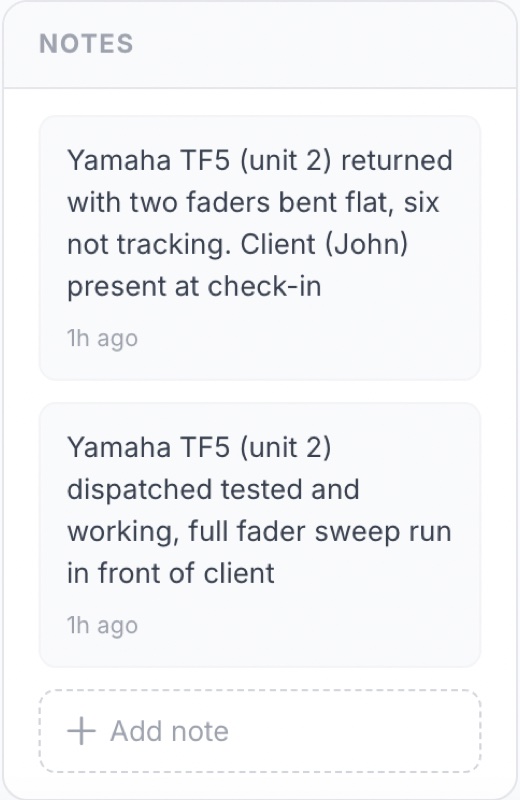
“Hi John, it’s Sam from Northside AV, about the Yamaha console from Saturday. When we checked it in that night, two faders were bent flat and six aren’t tracking. I wanted to walk you through it before anything shows up on paper.”
Point to the record.
Dispatch log, return photos, timestamps. Offer to send them before they ask, so it’s not a threat.
“Friday’s dispatch sheet has it logged as tested and working. You saw us run it at pickup. The return photos are timestamped Saturday night. I’ll send both side by side.”
Give the number.
Repair, loss of use, total, what it comes out of. One breath, no apology.
“Repair is quoted at $620, about a week at the service centre. Our agreement covers loss of use, six rental days at $145. $1,490 total, held against the $1,500 deposit. Nothing further to pay.”
Ask and go quiet.
One open question. Then let them talk. Whoever speaks next is negotiating against themselves.
“Does that match what your team saw? Anything I should know about how it happened?”
Then wait. Most customers, given the facts and the evidence up front, will tell you exactly what happened, the stage manager stacked a case on the console, a guest leaned on it, and the conversation becomes a confirmation, not a dispute.
Deposits and chargebacks
Cash or bank transfer
Hold the deposit, apply the charge, refund the balance with the documentation lines shown above.
Card deposit has two traps
An authorisation hold expires, usually within about a week, so your return check has to happen inside that window or the money is gone.
A captured deposit can still be charged back. The customer tells their bank “not as described” and the funds are pulled while it’s investigated.
What wins a chargeback
- Signed agreement
- Dispatch condition record
- Timestamped return photos
- Repair quote
- Your written notice
When the charge exceeds the deposit
Invoice the difference with the packet attached, 14-day terms. Follow up once. Then decide: chasing $200 costs more than $200; a $3,000 loss-of-use balance is worth pursuing. Set your threshold in advance, in writing.
Stopping the next one
- Document dispatch every time. Can’t photograph everything? Photograph everything over a value threshold plus consoles, projectors, moving heads and wireless. Signature before the van door closes.
- Ten minutes at pickup on dry hire. Power it on in front of them, confirm cables, point at the two things people break on that item.
- Damage waiver on every quote. A percentage of the rental fee, one paragraph on what it covers (accidental) and excludes (negligence, misuse, loss, theft). Doesn’t stop damage, stops the argument.
- COI for high-value dry hire. LED walls, line arrays, touring rigs. Total loss becomes an insurance claim, not collections.
- Read damage history per asset. Three bad returns in ten rentals is a fragile unit, the wrong clients, or a unit to retire. You only see it if condition is logged per item.
FAQ
Can I charge more than the deposit?
Yes, if the agreement makes the renter liable for damage and the deposit is security, not a cap. Invoice the difference with documentation.
They bought a damage waiver. Do I still charge?
Only for what it excludes, typically negligence, misuse, theft, loss, missing items. A drink in the console is usually negligence. Read your waiver wording first.
Customer disputed the card charge. Now what?
Respond with the packet: signed agreement, dispatch record, return photos, repair quote, your written notice.
Can I charge for lost rental income during repair?
Only with a loss-of-use clause. No clause, add one before the next rental.
Do I charge for wear and tear?
No. It’s in your rates and you’ll lose the dispute anyway.
They say they never signed anything.
Click-to-accept at booking with an audit trail is generally enforceable; check local rules. No agreement at all, negotiate this one and fix onboarding.
Before the next return
Check it before it’s shelved. Log condition per item. Hold the deposit before closing the booking. Decide who’s liable, wear or damage, dry or crewed, yours or cross-hired, before you dial. Bill in separate lines. Call with facts first and evidence already in the email.
Dispatch and return condition per asset, timestamped record on every return.
Start Free with LendControl →Questions about damage tracking? Email admin@lendcontrol.com and we’ll walk you through it.
No credit card required. Your data stays yours if you cancel.