
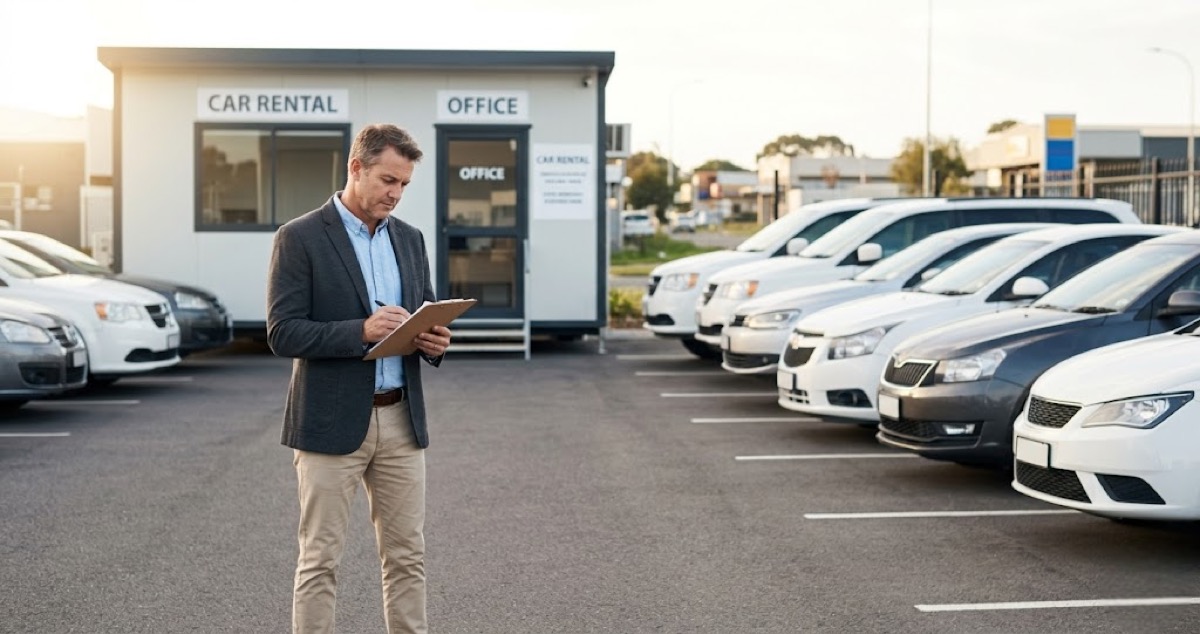
You would not hand someone the keys to a $35,000 vehicle without a signed contract. But plenty of small car rental operators launch with bare-minimum insurance and hope nothing goes wrong. That is a business-ending mistake.
Car rental insurance is not a single policy. It is a stack of coverages that protect:
- Your vehicles — collision, theft, and comprehensive damage
- Your business — liability claims and lawsuits
- Your employees — workers’ compensation and on-the-job incidents
- The people who rent from you — renter liability and supplemental coverage
Miss one layer and a single accident, theft, or lawsuit can wipe out everything you have built.
This guide covers every policy your car rental business actually needs, what each one costs, and how to avoid paying for coverage you do not need.

Why car rental insurance is not optional
A standard personal auto policy does not cover vehicles used for commercial rental. The moment you rent a car to someone for money, your personal coverage is void. Every major insurer explicitly excludes vehicles used in rental or livery service from personal auto policies.
Beyond that, most states require car rental businesses to carry specific minimum liability coverage.
- Florida — rental car companies must provide at least $100,000/$300,000 in bodily injury liability and $50,000 in property damage
- California — requires $30,000/$60,000/$15,000 minimum liability on all rental vehicles, updated January 1, 2025 under Senate Bill 1107
Requirements vary by state, and many exceed the standard minimums. If a renter causes an accident and you are underinsured, you — the business owner — are personally liable for the difference.
That is not a theoretical risk. The average cost of a bodily injury claim in the U.S. was $24,681 in 2022, and serious accidents routinely produce six- and seven-figure judgments.
Every type of coverage your car rental business needs
Car rental insurance is not one policy. It is a combination of coverages that work together. Here is what each one does and why you need it.
Commercial auto insurance
This is the foundation. Commercial auto insurance covers liability, collision, and comprehensive damage for every vehicle in your rental fleet. Unlike personal auto, it is rated for commercial use — meaning it covers vehicles driven by multiple renters throughout the year.
You need this on every single vehicle in your fleet. No exceptions. Policies are typically priced per vehicle, with rates varying based on vehicle type, location, and your claims history.
General liability insurance
General liability covers injuries and property damage that happen on your premises — not in your vehicles. A customer slips on your lot, trips over a curb at your rental counter, or their belongings are damaged during a vehicle exchange. This policy handles those claims.
Most commercial landlords require you to carry at least $1 million per occurrence in general liability before they will sign a lease.
Garage liability insurance
This one is specific to businesses that store, service, or rent vehicles. Garage liability combines general liability and auto liability into one policy tailored for vehicle-related businesses.
It covers bodily injury and property damage arising from your garage operations — including test drives, vehicle movements on your lot, and customer interactions at your location. For many small car rental operators, garage liability replaces the need for separate general liability and commercial auto policies.
Hired and non-owned auto insurance
If your employees ever drive vehicles that your business does not own — picking up a car from auction, running an errand in a personal vehicle, or driving a loaner — hired and non-owned auto (HNOA) insurance covers the liability gap. Without it, any accident in a non-fleet vehicle during business use falls on you personally.
Umbrella insurance
Umbrella policies kick in when a claim exceeds the limits of your underlying coverage. If your commercial auto policy has a $1 million limit and a serious accident produces a $2.5 million judgment, the umbrella covers the remaining $1.5 million.
For a car rental business, a $1-$5 million umbrella policy is standard.
How much car rental insurance actually costs
Insurance costs depend on fleet size, vehicle values, location, driving records of employees, and claims history. Here are realistic annual ranges for a small car rental operation with 10-25 vehicles.
| Coverage type | Estimated annual cost | What it covers |
|---|---|---|
| Commercial auto (per vehicle) | $1,200-$3,000/vehicle | Liability, collision, comprehensive for fleet vehicles |
| General liability | $500-$1,500/year | Premises injuries, property damage, advertising injury |
| Garage liability | $2,000-$5,000/year | Combined auto + premises liability for vehicle businesses |
| Hired & non-owned auto | $300-$800/year | Liability for non-fleet vehicles used in business |
| Umbrella ($1M-$5M) | $1,000-$3,500/year | Excess liability above underlying policy limits |
| Workers’ compensation | $540–$2,000/year for small businesses | Employee injuries on the job (source: Insureon) |
Total estimated range for a 15-vehicle fleet: $22,000-$52,000 per year, depending on location and coverage limits. Higher-value vehicles (luxury, SUVs) push premiums up. Older economy sedans bring them down.
That sounds like a lot. But compare it to a single uninsured accident claim averaging $24,000+ — or a lawsuit that hits seven figures. Insurance is not an expense. It is the cost of staying in business.
Compare your coverage options side by side
| Coverage | Covers vehicles? | Covers premises? | Covers employees? | Required by law? | Best for |
|---|---|---|---|---|---|
| Commercial auto | Yes | No | No (drivers only) | Yes (most states) | Every rental fleet |
| General liability | No | Yes | No | Often required by landlords | All businesses with a physical location |
| Garage liability | Yes | Yes | No | No (but highly recommended) | Vehicle-focused businesses wanting one policy |
| HNOA | Non-owned vehicles only | No | Yes (while driving) | No | Businesses where staff use personal cars |
| Umbrella | Extends all policies | Extends all policies | Extends all policies | No | Any business wanting higher limits |
| Workers’ comp | No | No | Yes | Yes (in most states) | Any business with employees |
What to offer your customers: CDW, LDW, and supplemental coverage
Beyond insuring your business, you can sell optional coverage to renters. This creates a revenue stream and reduces your exposure when renters cause damage.
Collision damage waiver (CDW)
A CDW is not technically insurance — it is a waiver where your business agrees not to hold the renter financially responsible for collision damage to the vehicle. Major rental companies charge $15-$35 per day for CDW. For a small operator, offering CDW at $15-$25/day adds meaningful revenue per booking.
Loss damage waiver (LDW)
LDW is broader than CDW. It covers collision damage plus theft, vandalism, and weather damage. National chains typically bundle LDW at $20-$45 per day. Smaller operators can price LDW at $20-$30/day and still be well below the national chains.
Supplemental liability insurance (SLI)
SLI increases the renter’s liability coverage beyond your fleet policy minimum. It is popular with renters who do not carry their own auto insurance. Typical pricing runs $10-$15 per day.
Personal effects coverage
Covers theft of a renter’s personal belongings from the vehicle. Typically $3-$5 per day. Low cost, low risk, easy add-on revenue.
Revenue impact of offering waivers
If 40% of your renters add LDW at $25/day on a 3-day average rental, that is $30 extra per booking. Across 300 rentals per year, that is $9,000 in additional revenue from waivers alone.
Where to buy car rental insurance for your business
Not every insurer writes policies for car rental operations. You need carriers that specialize in commercial auto and vehicle-rental risk.
- The Hartford — one of the largest commercial auto insurers in the U.S. Writes policies for vehicle rental businesses. Offers bundled commercial auto + general liability.
- Progressive Commercial — popular with small fleets. Get a quote at progressivecommercial.com as rates vary by state and fleet size.
- Insureon — a broker marketplace that connects you with multiple carriers. Useful for comparing quotes from several insurers in one place.
- NEXT Insurance — focuses on small businesses. Offers general liability and commercial auto with quick online quoting.
- Hiscox — strong for general liability and umbrella coverage for small businesses.
Get at least three quotes before committing. Premiums for the same coverage can vary by 30-50% between carriers.
Track your fleet and contracts digitally
Insurance only works if you can prove coverage, track signed waivers, and know exactly which vehicles are out on rental at any given time.
When a renter reports an accident, you need to pull up their rental contract instantly — what coverage they purchased, the vehicle condition at checkout, and the signed waiver. Digging through filing cabinets or email threads while an insurance adjuster waits is not a position you want to be in.
What to look for in a fleet management platform:
- Digital rental contracts with e-signatures — signed before the renter drives off the lot
- Real-time fleet tracking — know which vehicles are rented, available, or in maintenance
- Customer records — license verification, insurance info, and waiver status in one place
- Automated reminders — renewal alerts for your business insurance policies and vehicle registrations
LendControl handles all of this for small rental operations. One feature that stands out for car rental businesses: WhatsApp AI availability — a customer sends “Do you have any SUVs available this weekend?” and gets an instant answer from your live inventory. No phone tag. No back-and-forth emails.
Try LendControl free — no credit card required.
How to reduce your car rental insurance premiums
You do not have to accept the first quote you get. There are concrete steps to bring your premiums down without sacrificing coverage.
- Maintain a clean claims history — fewer claims means lower premiums at renewal
- Install GPS tracking and dash cameras — some insurers offer 10-15% discounts for telematics and fleet safety programs
- Choose higher deductibles — a higher deductible lowers your monthly premium, just make sure you can cover the deductible if a claim comes in
- Bundle multiple policies with one carrier — multi-policy discounts are common and can save 10-20%

Frequently asked questions
How much does car rental insurance cost for a small business?
For a fleet of 10-25 vehicles, expect to spend $22,000-$52,000 per year on a full insurance stack — commercial auto, general liability, umbrella, and workers’ comp. The biggest variable is per-vehicle commercial auto premiums, which run $1,200-$3,000 per vehicle depending on the car’s value and your location.
What is the difference between CDW and LDW?
CDW (collision damage waiver) covers only collision damage to the rental vehicle. LDW (loss damage waiver) is broader — it covers collision plus theft, vandalism, and weather damage. LDW costs more per day ($20-$45 vs. $15-$35) but offers more complete protection for the renter.
Do I need garage liability insurance for a car rental business?
Garage liability is not legally required in most states, but it is highly recommended. It combines general liability and auto liability into one policy designed for vehicle businesses. If you store, service, and rent vehicles from a physical location, garage liability simplifies your coverage and often costs less than carrying separate policies.
Can I use personal auto insurance for a rental fleet?
No. Personal auto policies explicitly exclude vehicles used for commercial rental. The moment you rent a vehicle for profit, personal coverage is void. You need commercial auto insurance rated for rental use. Operating without it exposes you to full personal liability for every accident.
Protect your car rental business before your first booking
Car rental insurance is not a line item you minimize — it is the foundation that keeps your business alive when something goes wrong. Get commercial auto on every vehicle, carry enough liability to survive a serious claim, and sell CDW/LDW to your renters for both protection and profit.
The operators who get burned are the ones who cut corners on coverage to save a few thousand dollars a year. Do not be that operator. Get properly insured, track every contract digitally, and run your business knowing you are covered.
Get Started for Free — no credit card required.