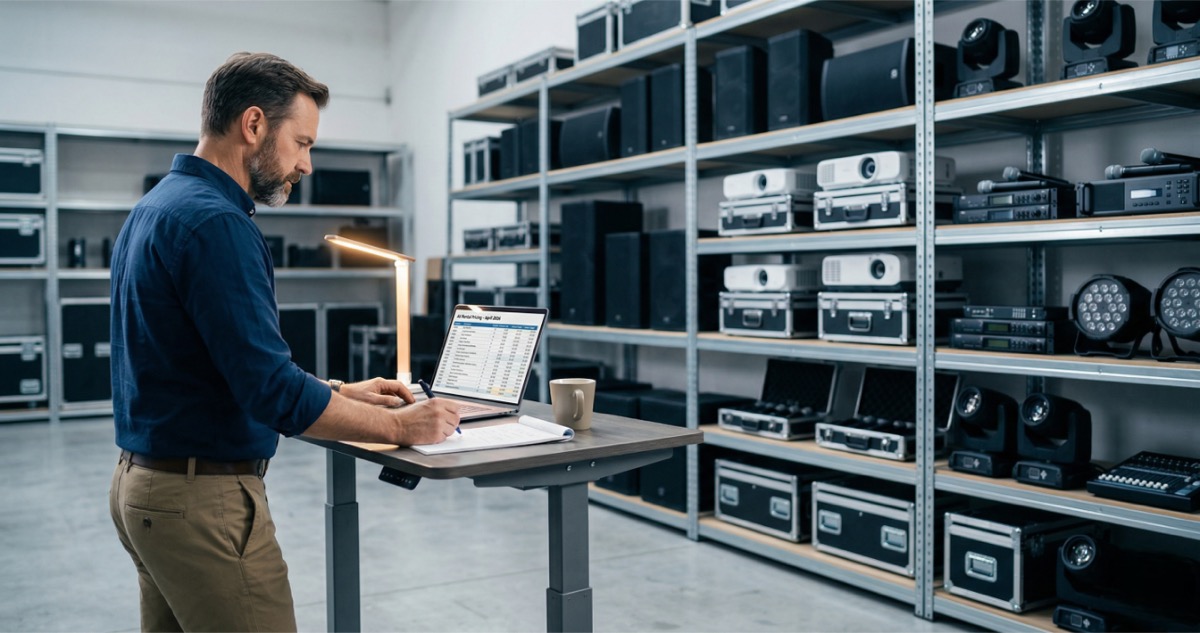

- A single projector falls off a rigging truss — at a corporate event.
- A $12,000 wireless microphone kit vanishes — from a venue overnight.
- A delivery van full of LED panels gets rear-ended — on the freeway.
Without the right AV rental insurance, any one of these wipes out months of profit — or kills your business outright.
The challenge is that audio visual equipment insurance isn’t a single policy you buy and forget. It’s a combination of coverage types, and most AV rental operators either carry too little or pay for overlapping policies they don’t actually need.
This guide breaks down exactly which policies you need, what they cost, and where most AV rental operators get caught with dangerous coverage gaps.

Why AV rental insurance is non-negotiable
AV equipment faces risks that most rental categories don’t. Your gear travels constantly, gets set up and torn down in unfamiliar venues, and operates around water, electricity, rigging, and crowds. The exposure is high and the asset values are steep.
Here’s what happens without proper coverage: a lighting truss collapses during load-in and injures a venue staffer. Without AV rental liability coverage, you’re paying medical bills, legal defense, and a potential settlement directly. According to the Insurance Information Institute, businesses that rely on movable high-value equipment are among the most exposed to uninsured loss.
Theft is equally common. Audio visual gear is portable, high-value, and easy to resell. The National Equipment Register estimates that equipment theft costs U.S. businesses between $300 million and $1 billion per year, and AV equipment is a frequent target because of its size-to-value ratio.
Beyond protecting your own assets, most venues and corporate clients require a certificate of insurance before they’ll let you load in. No insurance, no gig. Your AV rental business loses contracts before the bidding even starts.
The five policies that protect your AV rental business
Not all coverage is equally urgent. Here’s the stack that matters for AV rental operators, ranked by priority.
1. Inland marine insurance (equipment floater)
This is the single most important policy for any AV rental business. Your commercial property insurance covers equipment sitting in your warehouse. But the second that speaker system leaves your dock — in a truck, at a convention center, backstage at an outdoor festival — property insurance stops covering it.
Inland marine insurance (also called an equipment floater) covers your gear against theft, accidental damage, vandalism, and weather events while in transit or at off-site locations. For a business where equipment is out the door more than it’s in the warehouse, this is the policy that protects your revenue-generating assets.
Most AV rental operations carry inland marine policies valued at the total replacement cost of their active rental fleet. If your fleet is worth $250,000, your policy should cover $250,000.
2. General liability insurance
General liability covers third-party bodily injury and property damage claims from your business operations. If a speaker stack falls and injures an attendee, or your crew damages a venue floor during setup, this policy responds.
The standard for AV rental businesses is a $1,000,000 per occurrence / $2,000,000 aggregate policy. Most venues and event producers require at least this minimum before they’ll approve your load-in.
3. Commercial auto insurance
If you deliver equipment in company vehicles — box trucks, cargo vans, trailers — you need commercial auto coverage. Personal auto policies exclude business use entirely, and a single highway accident with $150,000 of AV gear in the back can result in six-figure claims.
Commercial auto covers your vehicles, drivers, and cargo during transport. For AV companies running multiple trucks to events across a metro area, this is a weekly exposure, not a hypothetical.
4. Workers’ compensation insurance
AV rental work involves heavy lifting, rigging at height, electrical connections, and late-night load-outs. Injury risk is real. If you have employees, most states require workers’ compensation coverage to handle medical bills and lost wages when someone gets hurt on the job.
Even if your state exempts very small teams, carrying workers’ comp protects you from personal lawsuits by injured crew members.
5. Commercial umbrella insurance
Umbrella coverage kicks in when a claim exceeds the limits of your underlying policies. A $1 million general liability policy feels adequate — until a serious injury lawsuit at a large event pushes past that ceiling.
A $1 million umbrella policy costs roughly $450-$1,200 per year, which is a fraction of what you’d pay to cover a gap out of pocket.
What AV rental insurance actually costs
Here’s what small to mid-sized AV rental businesses typically pay in the U.S. Your actual costs will vary based on fleet value, location, employee count, and claims history.
| Policy | Avg. Monthly Cost | Avg. Annual Cost |
|---|---|---|
| Inland marine / equipment floater | $25–$100/mo | $300–$1,200/yr |
| General liability ($1M/$2M) | $37–$99/mo | $450–$1,200/yr |
| Commercial auto (per vehicle) | $147–$245/mo | $1,764–$2,940/yr |
| Workers’ compensation | $54–$86/mo | $643–$1,032/yr |
| Commercial umbrella ($1M) | $38–$100/mo | $450–$1,200/yr |
Total estimated range: $1,500–$3,500/year for basic coverage (inland marine + general liability). For a mid-sized AV rental business with vehicles and crew, expect $4,000–$8,500/year for a full coverage stack.
Inland marine premiums scale with fleet value. A $100,000 fleet might cost $300–$500/year for inland marine alone. A $500,000 fleet could run $800–$1,500/year. The rate typically falls between 1–3% of total insured equipment value, depending on your risk profile.
Damage waivers: turn risk into revenue
A damage waiver isn’t an insurance policy — it’s a fee you charge customers that limits their financial liability when rented equipment gets damaged. You absorb the repair cost (or claim it through your inland marine policy), and the customer pays a predictable fee at booking time.
How to price damage waivers for AV gear
Most rental businesses charge 8–14% of the rental rate as a damage waiver fee. AV equipment tends to sit at the higher end of that range because of the fragility and replacement cost.
Example: you rent a wireless microphone kit for $350/day. A 12% damage waiver adds $42/day. Over 15 rental days in a month, that’s $630 in waiver revenue from a single kit — pure margin in months where nothing breaks.
Named perils vs. all-risk
- Named perils — covers only specific events listed in the contract (theft, fire, vandalism). Lower risk for you, lower perceived value for the customer.
- All-risk — covers everything unless specifically excluded. Higher perceived value, and you can charge a premium for it.
For high-value AV rentals, offering both tiers gives customers a choice and lets you capture more waiver revenue on premium bookings.
Lock it into your rental contracts
Make sure your rental contracts spell out exactly what the damage waiver covers, what it excludes, and what the customer’s liability cap is. Vague language leads to disputes after a $9,000 projector lens cracks at load-out. Clear terms protect both sides.
How to keep your premiums from gutting your margins
Audio visual equipment insurance is a fixed cost, but it doesn’t have to be an uncontrolled one. Here’s how experienced AV rental operators keep premiums manageable.
Bundle your policies
Buying general liability, property, and inland marine from the same carrier typically qualifies you for a Business Owner’s Policy (BOP) discount. Carriers like The Hartford and Nationwide offer bundled packages that can save 10–15% versus separate policies.
Raise your deductibles strategically
A $2,500 deductible instead of $1,000 lowers your annual premiums. Just make sure your cash reserves can absorb that deductible if a claim hits. For AV businesses with strong cash flow, higher deductibles are usually the smarter trade.
Document everything
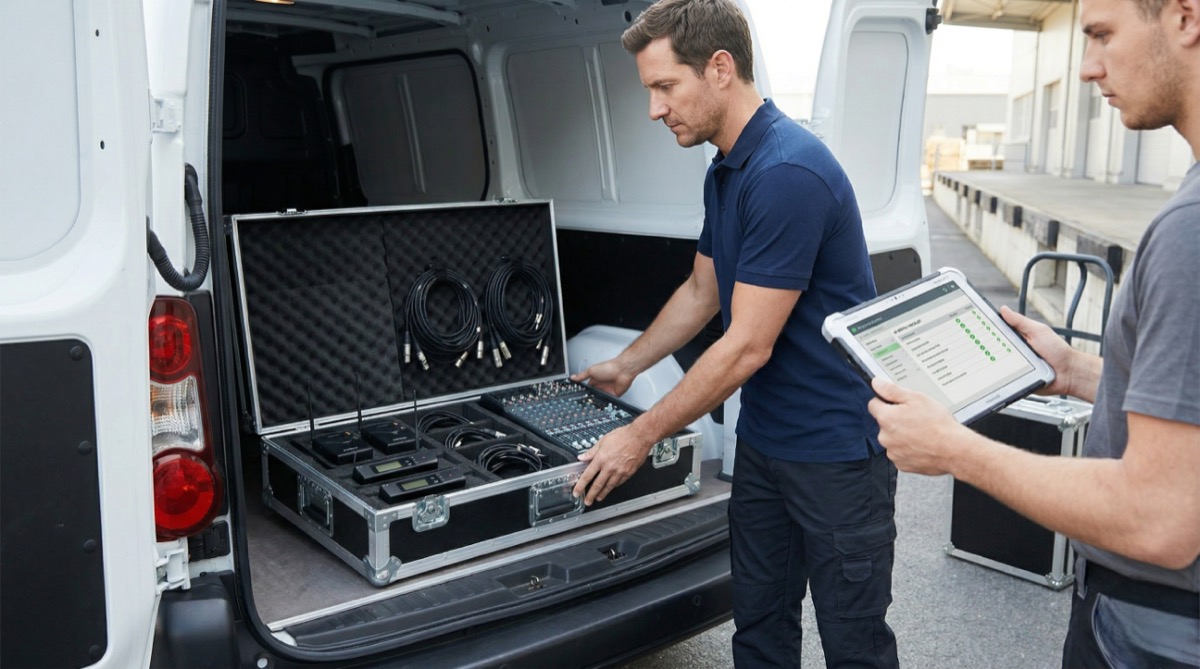
Insurers reward operators who demonstrate organized risk management. When you can show maintenance logs, signed rental contracts, equipment condition reports at checkout and return, and a complete customer communication trail, you present as a lower-risk client.
Some carriers offer preferred rates to businesses that track operations digitally rather than on paper.
Review coverage annually
Your fleet changes constantly — you add LED panels, retire aging projectors, expand into new markets. If your policy still reflects last year’s inventory, you’re either overpaying for gear you sold or underinsured on new purchases. Schedule an annual review with your broker every time your fleet value shifts by more than 15%.

Frequently asked questions
How much does AV rental insurance cost per year?
Basic coverage (general liability plus inland marine) runs $1,500–$3,500/year for a small AV rental business. Add commercial auto, workers’ comp, and umbrella coverage and the total reaches $4,000–$8,500 annually depending on fleet value and team size. Inland marine premiums specifically scale with your total insured equipment value — typically 1–3% of total fleet value.
Do I need inland marine insurance if my gear stays local?
Yes. Your commercial property insurance only covers equipment at your business address. The moment a speaker system leaves your warehouse — whether it’s going across town or across the state — property insurance stops applying. Inland marine covers your equipment in transit, at venues, and at any off-site location. For an AV rental business, this is the most critical policy after general liability.
What’s the difference between a damage waiver and audio visual equipment insurance?
Insurance is a policy you purchase from a carrier to protect your business from financial loss. A damage waiver is a fee you charge your customers that caps their liability if equipment gets damaged during a rental. They work together: the waiver generates revenue and reduces disputes with clients, while your inland marine policy covers actual repair or replacement costs. Damage waivers typically run 8–14% of the rental rate.
Which insurance companies cover AV rental businesses?
Several carriers offer coverage suitable for AV rental operations. The Hartford has equipment and party rental insurance packages. Insureon is a strong marketplace for comparing inland marine quotes. Nationwide offers inland marine and BOP bundles. For specialized AV and event industry coverage, brokers like Risk Placement Services (RPS) focus specifically on the rental sector.
Can I require customers to carry their own insurance?
Yes, and many AV rental operators do for high-value rentals. You can require clients to provide a certificate of insurance naming your company as an additional insured on their general liability policy. This is standard practice for corporate events, festivals, and venue installs. It doesn’t replace your own coverage, but it adds a layer of protection and shows the client shares responsibility for the equipment while it’s in their care.
Protect your AV rental business before the next gig
AV rental insurance comes down to five policies: inland marine, general liability, commercial auto, workers’ comp, and umbrella coverage. You don’t need every policy on day one — start with inland marine and general liability, then layer in the rest as your fleet grows and you hire crew.
The real danger isn’t spending too much on premiums. It’s carrying too little coverage and finding out the hard way when a $20,000 LED wall gets stolen from a venue loading dock or a rigging failure injures someone at a live event. Get the right AV rental insurance in place early, keep your rental contracts airtight, and document every checkout, return, and condition report so you can prove where your gear is and what shape it’s in.
Ready to keep your rental contracts and insurance documents organized?
No credit card required.