
People rent equipment because buying does not make sense for a one-time job. A homeowner remodeling a bathroom does not need to own a concrete saw. A landscaper picking up a side job does not want to finance a $40,000 mini excavator. That gap between “I need this tool” and “I don’t need to own it” is where your equipment rental business lives.
And the gap is getting wider. The U.S. equipment rental industry is projected to hit $80.5 billion in revenue in 2025, with growth continuing to $82.3 billion in 2026 (American Rental Association). Contractors are shifting from buying to renting to keep cash free for labor and materials. DIYers are following the same logic.
Here is how to start an equipment rental business that actually makes money — from picking your niche to booking your first rental.
Why the equipment rental industry is worth getting into
The economics of equipment rental are straightforward: you buy an asset once, then rent it out dozens or hundreds of times. A well-utilized piece of equipment can pay for itself within a year.
The global construction equipment rental market was valued at $132.35 billion in 2025 and is projected to reach $229.19 billion by 2034, growing at a CAGR of 6.4% (Fortune Business Insights). That growth is not limited to construction — landscaping, power tools, and general tool rental are all expanding as more people choose renting over buying.
A few things working in your favor right now:
- Contractors prefer renting. High interest rates and equipment costs mean fewer contractors are financing purchases. They rent what they need per project instead.
- DIY demand is growing. Homeowners tackling renovation and landscaping projects need professional-grade tools without the professional-grade price tag.
- Low overhead compared to retail. You do not carry perishable inventory. Equipment depreciates, but a well-maintained mini excavator rents for years.
This is not a get-rich-quick business. But it is a business with strong recurring revenue if you pick the right equipment and manage utilization rates.
Pick the right equipment niche
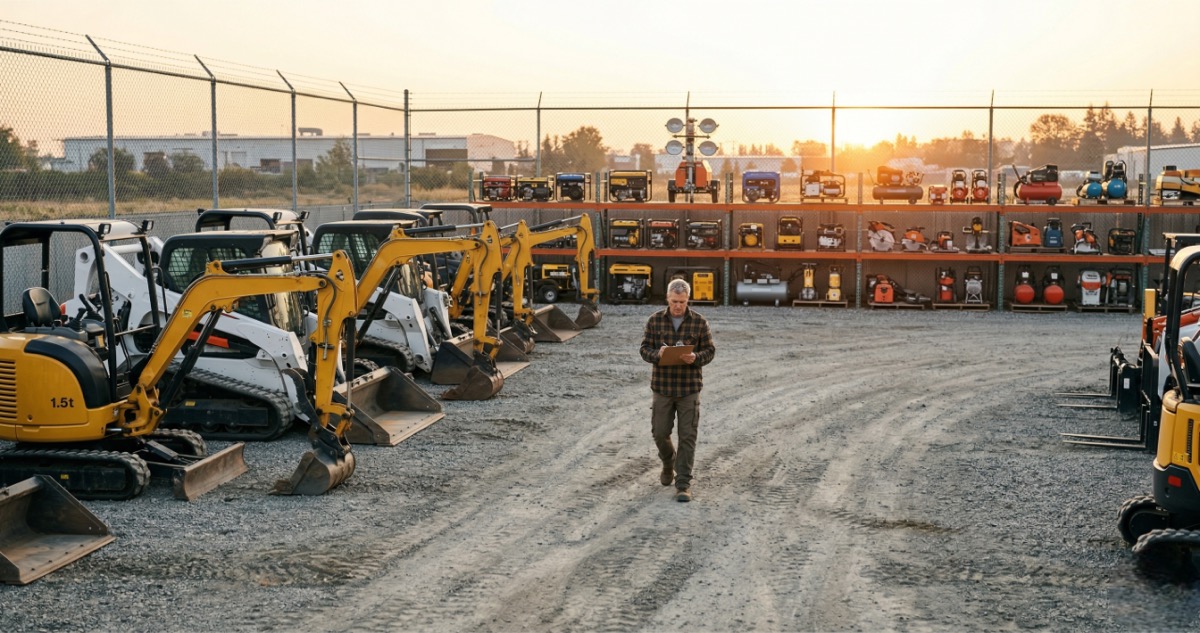
You cannot rent everything to everyone — at least not on day one. The most profitable equipment rental businesses start narrow and expand once they have cash flow.
Here are the equipment categories with the strongest rental demand:
Construction equipment
- Mini excavators — One of the most profitable rental categories. Acquisition costs range from $20,000-$60,000, and they typically rent for $300-$650/day (Quipli). At 50% utilization, you can hit ROI within 100-150 rental days.
- Skid steers — The single most rented piece of equipment across all industries. Compact, versatile, and in demand from contractors, landscapers, and DIYers alike (TapGoods).
- Dump and utility trailers — Lower acquisition cost, consistent demand. One dump trailer renting at around $300/day can generate $50,000+ in gross profit per year (Quipli).
Landscaping and outdoor
- Trenchers — Average rental rates of $125-$300/day. High demand in areas with active construction and landscaping (Quipli).
- Stump grinders — Among the most searched-for rental tools, especially in suburban markets with mature tree cover.
Power tools and general equipment
- Concrete saws, pressure washers, generators — Lower price point to acquire, high volume of short-term rentals. Good entry point if your budget is under $30,000.
Pick a niche based on what your local market needs. If you are near active construction, lean toward excavators and skid steers. If your area is more residential, power tools and landscaping equipment may have faster turnover.
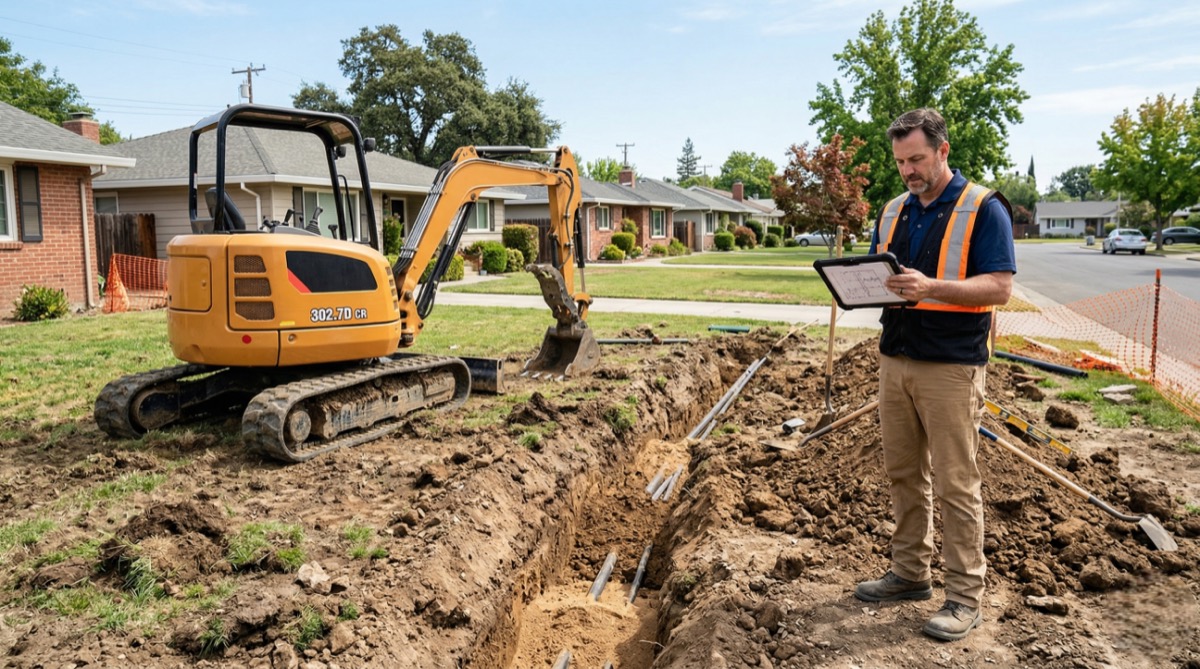
Figure out your real startup costs
Startup costs for an equipment rental business depend heavily on what you are renting. Here is a realistic breakdown for a small to mid-sized operation.
Equipment (your biggest expense)
| Category | Starter Investment | Example |
|---|---|---|
| Power tools only | $10,000-$30,000 | Pressure washers, concrete saws, generators |
| Landscaping equipment | $25,000-$75,000 | Trenchers, stump grinders, skid steer |
| Construction equipment | $50,000-$150,000+ | Mini excavator, skid steer, dump trailer |
You do not need to buy everything new. Used equipment in good condition cuts your upfront cost by 30-50%. Check auction sites, dealer trade-ins, and retiring operators looking to sell their fleet.
Other startup costs
- Storage/yard space: $500-$2,000/month depending on location and size. You need secure, accessible space for equipment and a spot for customers to pick up.
- Delivery vehicle/trailer: $5,000-$25,000. Larger equipment requires a truck and trailer for delivery. Some operators start with customer pickup only to avoid this cost.
- Insurance: $500-$1,200/year for general liability (General Liability Insure). Inland marine insurance to cover your equipment adds more — budget $2,000-$5,000/year depending on fleet value.
- Business registration and licenses: $50-$500 depending on your state and city (Step By Step Business).
- Software: $35-$150/month for rental management software to handle bookings, inventory, and payments.
- Website and marketing: $500-$2,000 to set up. Google Business Profile is free and critical.
Total realistic range for a small equipment rental startup: $15,000-$60,000 for a power tool or general equipment operation. $50,000-$150,000+ if you are going into construction equipment (Financial Models Lab).
Ready to manage your rental inventory from day one?
Try LendControl free for 14 days
No credit card required.
Handle the legal and insurance basics
Skipping this section costs people far more than any equipment purchase. Get your legal and insurance foundation set before your first rental.
Business structure
Form an LLC. It protects your personal assets if a renter damages property with your equipment or gets injured on a job site. An LLC is fast to set up in most states — typically $50-$500 in filing fees — and it separates your business liability from your personal finances (Step By Step Business).
After filing your LLC, get an EIN (Employer Identification Number) from the IRS. It is free and takes five minutes online. You will need it to open a business bank account and file taxes.
Licenses and permits
Requirements vary by location, but most equipment rental businesses need:
- General business license from your city or county
- Sales tax permit if your state charges sales tax on rentals (most do)
- Zoning permit if you are storing equipment on commercial or residential property
- DBA filing if your business name differs from your LLC name
Check your state’s Secretary of State website and your local county clerk for specific requirements. Fees typically run $50-$500/year (Biz Bandit Raccoon).
Insurance you actually need
- General liability insurance: Covers third-party injuries and property damage. Expect $37-$99/month for a standard $1M/$2M policy (General Liability Insure).
- Inland marine insurance: Covers your equipment while it is in transit or on a customer’s job site. Essential for expensive machinery.
- Commercial auto insurance: Required if you are delivering equipment with a business vehicle.
- Rental damage waivers: Optional coverage you can sell to customers that covers accidental damage to your equipment. This protects your assets and creates an additional revenue stream.
Set your rental pricing
Your pricing needs to cover three things: equipment depreciation, operating costs, and profit. Here is a simple framework.
The 1% rule (starting point)
A common industry benchmark: charge 1-2% of the equipment’s replacement value per day as your daily rental rate. A $30,000 mini excavator would rent for $300-$600/day. A $500 pressure washer would rent for $50-$75/day.
Offer tiered rates
- Daily rate — your highest per-day price
- Weekly rate — typically 3-4x the daily rate (discount for longer commitment)
- Monthly rate — typically 10-14x the daily rate
Factor in your costs
For each piece of equipment, calculate:
- Depreciation per rental day (purchase price / expected useful rental days)
- Maintenance cost per rental (repairs, cleaning, fuel top-offs)
- Insurance cost per day (annual insurance / 365)
- Delivery cost (fuel + driver time, if applicable)
If your total cost per rental day is $120 and you are charging $350/day, you have healthy margins. If it is $280 and you are charging $350, you need to raise prices or cut costs.
Get your first customers
You have equipment, insurance, and pricing. Now you need people to actually rent from you.
Local visibility first
- Google Business Profile — Set this up immediately. When someone searches “equipment rental near me,” this is what shows up. Add photos of your equipment, your pricing, and your service area.
- Facebook Marketplace — List individual pieces of equipment for rent. Many small contractors and homeowners search here before going to Google.
- Local contractor networks — Introduce yourself to general contractors, landscapers, and property managers in your area. These are your repeat customers.
Build for repeat business
The equipment rental business thrives on repeat customers. A contractor who rents a skid steer for one project will rent again if the experience is smooth. Focus on:
- Fast availability answers. When someone asks “Do you have a trencher available Thursday?” they need an answer in minutes, not hours.
- Easy booking. The fewer steps between “I need this” and “It’s reserved,” the more bookings you close.
- Reliable equipment. Nothing kills a rental business faster than equipment that breaks down on the job site. Maintain everything on schedule.
Use equipment rental software to run the business
Spreadsheets work when you have three pieces of equipment and five customers. They fall apart fast. Once you are managing multiple bookings, tracking availability across a fleet, and chasing payments, you need equipment rental software to keep things running.
What to look for in rental management software
- Real-time inventory tracking — Know what is available, what is out, and what is coming back, without checking a spreadsheet.
- Online booking — Let customers reserve equipment without calling you. You will lose bookings every time someone has to wait for a reply.
- Payment processing — Collect deposits and payments online. Chase fewer invoices.
- Customer management — Track rental history, contact info, and communication in one place.
Software costs
Equipment rental software typically runs $35-$150/month for small businesses, depending on features and fleet size. Enterprise platforms like EZRentOut start at $89/month (EZRentOut). Simpler tools built for small operators cost less.
LendControl is built for small rental businesses. It covers inventory, bookings, customers, and payments — and it includes a WhatsApp AI integration where your customers can ask natural language questions like “Do you have a pressure washer available on the 15th?” and get instant answers pulled from your live inventory. No forms, no waiting for you to manually check.
Frequently asked questions
How much does it cost to start an equipment rental business?
It depends on your niche. A small power tool rental operation can start for $15,000-$30,000. If you are renting construction equipment like mini excavators and skid steers, expect $50,000-$150,000+ including equipment, storage, insurance, and licensing (Financial Models Lab). Starting with used equipment and customer pickup (no delivery vehicle) keeps costs at the lower end.
What is the most profitable equipment to rent out?
Mini excavators, skid steers, and dump trailers consistently rank as the most profitable rental equipment. A single dump trailer renting at ~$300/day can generate over $50,000 in gross profit per year (Quipli). Skid steers are the most rented equipment overall due to their versatility across industries.
Do I need a special license to rent equipment?
In most states, you need a general business license, a sales tax permit, and proper zoning approval for your storage location. You do not typically need a special “equipment rental license,” but requirements vary by city and state. Check your local county clerk and state Secretary of State website for specifics.
How long does it take for an equipment rental business to become profitable?
Most rental businesses reach consistent profitability within 12-18 months (Booqable). The timeline depends on equipment utilization rates, pricing, and how quickly you build a customer base. Higher-value equipment (excavators, skid steers) can pay for itself faster per unit but requires more upfront capital.
Do I need rental management software from the start?
You can survive with spreadsheets for the first few weeks, but you will outgrow them fast. Once you have more than 3-5 pieces of equipment and regular bookings, tracking availability manually leads to double-bookings and missed revenue. Rental management software pays for itself by preventing those mistakes.
Start your equipment rental business the right way
Starting an equipment rental business comes down to a few things done well:
- Pick a niche your local market needs
- Buy equipment you can actually keep utilized
- Lock in your legal and insurance foundations
- Make it easy for customers to find you and book
The industry is not slowing down. With $82.3 billion in projected U.S. rental revenue for 2026 (ARA), there is room for operators who provide reliable equipment and a smooth rental experience.
You do not need a massive fleet to get started. You need a few solid pieces of equipment, a system to manage bookings, and customers who keep coming back.
Ready to launch your equipment rental business?
Try LendControl free for 14 days
No credit card required.